
Date: 2025-10-25
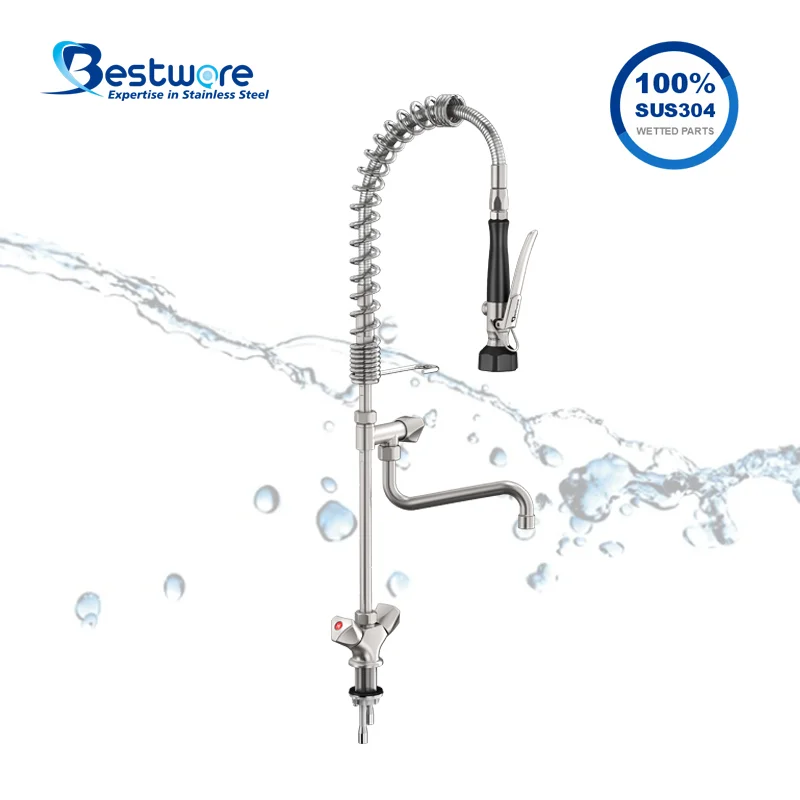
In heavy-use environments such as commercial kitchens and food processing facilities, pre rinse faucets are critical for ensuring cleaning efficiency and operational reliability. Stainless steel has emerged as the preferred material for commercial faucets due to its lead-free safety, environmental sustainability, corrosion resistance, and ease of cleaning. However, many procurement professionals often ask: although stainless steel costs less than brass as a raw material, why are stainless steel faucets more expensive overall? This "cheaper material, more expensive product" situation stems not only from the material itself, but also from systemic factors including machining difficulty, production lead time, equipment investment, and the overall manufacturing process. This article provides a comprehensive analysis of why stainless steel faucets come with a higher total cost and helps buyers better understand their long-term value.
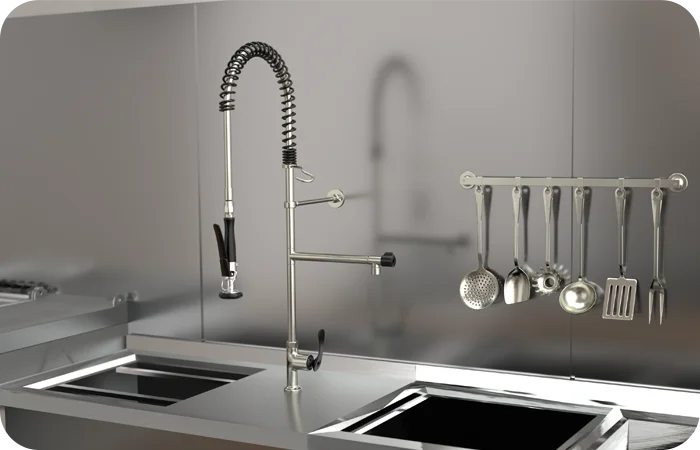
In terms of raw material cost, stainless steel is considerably cheaper than brass. In today's market, the price of brass per unit weight is typically two to three times higher than that of stainless steel. This is one of the main reasons many buyers assume that stainless steel faucets should be cheaper. However, raw material cost is only one component of the cost structure. More importantly, the differences in physical properties and machinability between the two materials directly affect manufacturing complexity and the required investment.
Stainless steel has high hardness and a high melting point. These properties give it excellent corrosion resistance and structural integrity but also make it much harder to machine. During processing, heat accumulates more easily, raising cutting temperatures and increasing tool wear and cutting resistance. As a result, it places higher demands on machine power, rigidity, and cutting parameters. In contrast, brass is softer, has a lower melting point, and excellent malleability. It is regarded as an easy-to-machine material, widely used in conventional faucet manufacturing. Due to these differences, stainless steel requires significantly more processing time and places greater demands on equipment during cutting, threading, and polishing. Ultimately, even though the raw material itself is cheaper, the total manufacturing cost is often higher than that of brass. This is mainly reflected in two aspects:

Image by brgfx on Freepik
The fundamental differences in physical properties such as hardness and melting point between stainless steel and brass result in a significant gap in manufacturing complexity and processing efficiency. In actual production, stainless steel is considerably more time-consuming and complex than brass at nearly every critical stage, placing higher demands on equipment and personnel, which further drives up overall manufacturing costs.
In the casting stage, brass products typically use reusable metal molds. Once the mold preparation is complete, casting can usually be finished within 2-3 days. In contrast, stainless steel casting employs investment casting, where the mold shell is built up layer by layer through repeated slurry dipping and stuccoing around seven times. The entire process—including wax pattern making, shell building, drying, pouring, and shell removal—can take nearly one month. Moreover, the molds are single-use and must be remade for each batch, significantly extending the preparation lead time.
During core machining processes, stainless steel machining is significantly slower than that of brass. For example, threading a brass component typically takes only about 5 seconds, whereas achieving the same precision with stainless steel often requires more than 2 minutes. In polishing, stainless steel's high hardness and large surface tension result in high machining resistance, making the overall polishing efficiency about half that of brass.
Regarding surface treatment, brass products commonly undergo batch electroplating. The plating layer provides strong coverage, masking minor casting defects and allowing for higher processing tolerance. This mature and stable process generally takes 1.5–2.5 hours per batch, averaging around 3–5 minutes per piece. Stainless steel products mostly adopt a brushed finish for surface treatment, which requires a high degree of substrate flatness. Visible lines and scratches are more likely to appear during processing. To further enhance corrosion resistance, additional pickling and passivation treatments are required. The entire surface treatment for a single piece usually takes between 30–60 minutes, making the process more complex and time-consuming.
Overall, the standard production cycle for brass products is typically around 15 days, whereas stainless steel products generally require 45 days or more. The extended production lead time not only increases supply chain pressure and inventory challenges but also results in greater capital tie-up and time costs, further impacting overall operational efficiency.
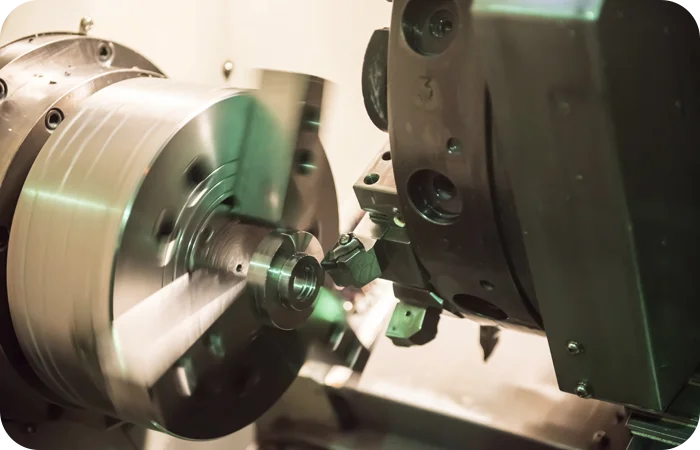
Image by onlyyouqj on Freepik
Compared with brass that offers excellent processing performance, stainless steel with high hardness and superior corrosion resistance places significantly higher demands on equipment, tooling and machining parameters. Brass features low cutting resistance and good thermal conductivity, making it suitable for high-speed machining with low tool wear and high efficiency, and is widely used in mass production.
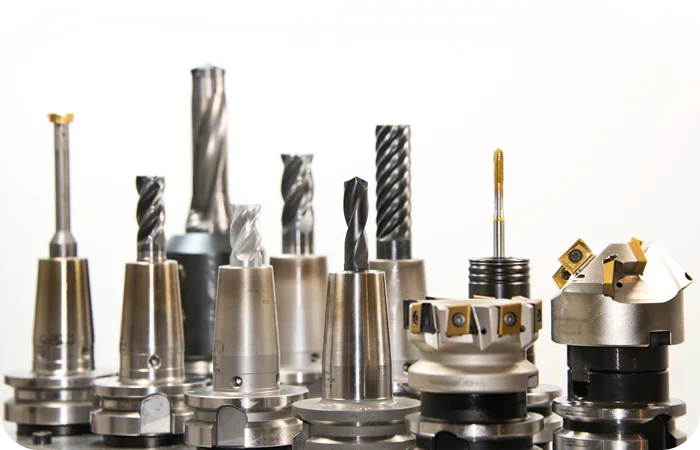
In contrast, stainless steel requires high-hardness, heat-resistant tools such as those made of cemented carbide or CBN, along with efficient cooling systems to manage the high temperatures and tool wear generated during machining. Cutting speed, feed rate, and other parameters must be precisely controlled to avoid issues such as thermal deformation, surface burns, or machining errors. These challenges not only prolong the production cycle but also place greater demands on equipment performance.
In terms of equipment investment, dedicated stainless steel machines must offer greater rigidity and precision, and their purchase cost is typically 1–2 times higher than that of brass-processing machines. Moreover, stainless steel machining demands a higher level of operator skill, further contributing to the overall increase in manufacturing costs.
Although stainless steel offers some advantages in terms of raw material pricing, its overall manufacturing cost is significantly higher than that of brass due to greater processing difficulty, longer production cycles, and higher equipment investment. To help buyers better understand the cost structure differences between the two, we present a relative cost comparison of raw material and processing costs for stainless steel and brass faucets, as shown in the table below:
|
Material |
Raw Material Cost1 (Relative Multiple) |
Raw Material Proportion |
Processing Cost2 (Relative Multiple) |
Processing Proportion |
Total Cost (Relative Multiple) |
|
SUS304 |
1.0 |
20% |
6.0 |
80% |
5.0 |
|
Brass |
2.5 |
60% |
1.0 |
40% |
1.9 |
1. Using SUS304 as the reference value (1.0) for raw material cost
2. Using brass as the reference value (1.0) for processing cost
Note: The above data represent normalized values and are for illustrative purposes only to highlight the cost structure differences between stainless steel and brass in the manufacturing process.
In conclusion, although stainless steel has a much lower raw material cost than brass, its high processing difficulty, long production cycle, and substantial equipment investment greatly increase process-related costs, making the overall manufacturing cost more than twice that of brass products.

Image by stockgiu on Freepik
Although stainless steel faucets involve significantly higher manufacturing costs than brass, they offer superior long-term value in terms of durability, reliability, health, and environmental sustainability, particularly in high-demand commercial settings. For buyers focused on system stability and total cost of ownership, stainless steel may require a higher initial investment, but it effectively reduces long-term maintenance frequency and minimizes the risk of operational disruptions. Firstly, stainless steel does not require electroplating, avoiding the maintenance issues caused by coating degradation and the environmental impact of the plating process, extending product lifespan. Secondly, its outstanding corrosion and wear resistance efficiently prevents malfunctions such as leakage or sticking, reducing the need for component replacements and labor costs for maintenance, ensuring business continuity. In addition, stainless steel is also a lead-free material that does not produce copper patina, making it a healthier and more eco-friendly choice. In contrast, brass is softer and more prone to oxidation, making it more susceptible to damage and leaks over time. This leads to higher maintenance costs and the rising electroplating expenses further add to the burden. From health, safety, durability, sustainability to cost control, stainless steel faucets deliver comprehensive advantages that bring more sustainable long-term value for users.

Image by rawpixel.com on Freepik
An increasing number of commercial clients regard stainless steel faucets as a trusted long-term solution. However, fully realizing the performance benefits requires a deep understanding of material properties, casting techniques, and quality control. As a premier solution provider of one-stop stainless steel commercial faucets, Bestware has long led the stainless steel revolution in this industry with proprietary core technologies. It is one of the earliest and most experienced integrated manufacturers combining R&D, production, and sales in the industry. The company continues to deliver stable, reliable product support for high-standard commercial clients worldwide.
2025/10/24 0:00:00
2025/10/15 0:00:00
One-stop Solution Provider of Stainless Steel Commercial Faucets
Email: business@bestware-stainless.com
after-sales@bestware-stainless.com
Tel: +86 18929047065
WhatsApp: +86 18929047065


WeChat: +86 18929047065


Website: www.bestware-stainless.com(Global Site)
www.bestware-sparkling.com(Water Dispenser)
Add: Block 8, No. 6, Jianda Nan Road, Jiangmen, Guangdong, China
Copyright © Bestware Hardware Production Co., Ltd. All Rights Reserved.
(2).webp)
(1).webp)