Date: 2026-06-12
Handwashing facilities play a vital role in maintaining hygiene in public spaces. Beyond user convenience, their design can also influence sanitation management and operational efficiency. As sensor technology and automatic soap dispensing systems continue to evolve, an increasing number of washrooms are adopting integrated solutions that combine a soap dispenser and sensor faucet into a single unit.By streamlining the handwashing process and optimizing fixture layout, integrated soap dispenser sensor faucets offer a practical solution for commercial buildings, healthcare facilities, hotels, educational institutions, and other public environments. This article explores what these products are, their key advantages, and why they are becoming increasingly popular.
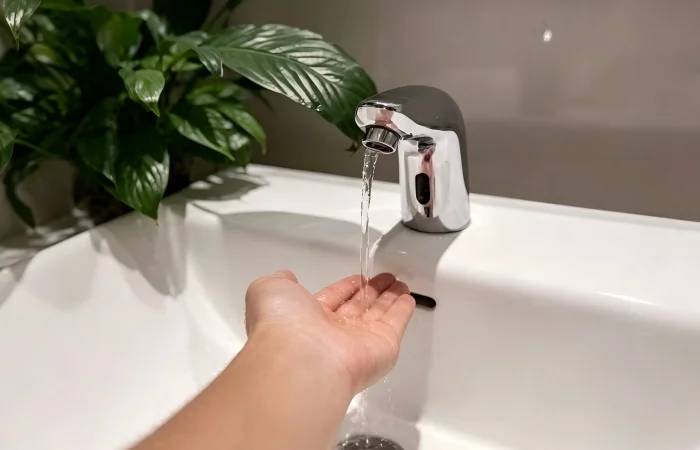
An integrated soap dispenser sensor faucet is a smart handwashing fixture that combines automatic soap dispensing and touchless water activation into a single device.Unlike traditional setups that require a separate soap dispenser and sensor faucet, this all-in-one design allows users to dispense soap and activate water flow within the same washing area, creating a more streamlined handwashing experience.Depending on the design, these faucets are typically equipped with independent sensing systems that control soap dispensing and water activation separately. Users can complete the entire handwashing process—from dispensing soap to rinsing—without touching the fixture, making these products a popular choice for healthcare facilities, schools, hotels, office buildings, and other public washrooms.
As hygiene standards and user expectations continue to rise, traditional handwashing stations that use separate sensor faucets and soap dispensers are beginning to reveal several limitations in commercial and public environments.
|
No. |
Limitation |
Impact |
|
1 |
Separate sensor faucet and soap dispenser installations |
Users must move between different fixtures during handwashing |
|
2 |
More individual fixtures required |
Increased countertop and installation space consumption |
|
3 |
Separate maintenance and refilling |
Higher workload for facility management |
|
4 |
Independent wiring or power supplies |
More complicated installation and servicing |
|
5 |
Dispersed fixture layout |
Less cohesive and visually appealing washroom design |
Although traditional systems continue to meet basic handwashing requirements, the growing demand for smarter and more integrated washroom solutions has encouraged many facilities to explore more efficient alternatives.
Designed to address the shortcomings of traditional handwashing stations, integrated soap dispenser sensor faucets offer several advantages for commercial and public washrooms.
|
No. |
Benefit |
Description |
|
1 |
Simplified handwashing process |
Soap dispensing and water activation are combined within a single fixture for a smoother user experience |
|
2 |
Space-saving design |
Eliminates the need for separate soap dispensers and reduces countertop clutter |
|
3 |
Improved hygiene management |
Touch-free operation helps minimize contact with surfaces |
|
4 |
Enhanced aesthetics |
Creates a cleaner and more organized washroom appearance |
|
5 |
Easier facility management |
Fewer devices simplify maintenance and inventory management |
As modern washrooms increasingly prioritize hygiene, convenience, and aesthetics, integrated soap dispenser sensor faucets are becoming a preferred choice across various industries.
Because they combine automatic soap dispensing and touchless water control into a single fixture, integrated soap dispenser sensor faucets are particularly well suited for environments where hygiene, space efficiency, and user experience are important.
Healthcare environments require strict hand hygiene standards. Hospital wash stations, for example, must support frequent handwashing by medical professionals throughout the day.
Hotels place a strong emphasis on guest experience and washroom aesthetics. Integrated fixtures help create a cleaner, more premium appearance in public restrooms and guest facilities.
Office washrooms often serve a large number of users daily. During peak hours, touchless integrated fixtures can help improve efficiency and reduce congestion.
School washrooms typically experience high usage rates, particularly during breaks when students wash their hands simultaneously.
The foodservice industry relies heavily on proper hygiene practices. Kitchen staff frequently wash their hands before and after handling food, making touchless solutions especially valuable.
Shopping malls, transportation hubs, airports, and other public facilities often experience heavy traffic. Integrated sensor faucets help support efficient hygiene management while improving user convenience.
As smart washroom technologies continue to gain adoption, integrated soap dispenser sensor faucets are finding their way into a growing range of commercial and public applications.
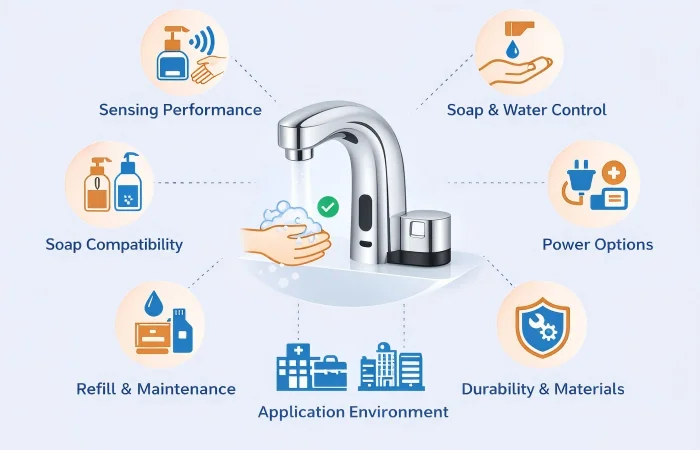
When selecting an integrated soap dispenser sensor faucet, sensor performance should be one of the first factors to evaluate. Detection range and response speed have a direct impact on the user experience. Sensors that are overly sensitive or slow to respond may affect normal operation.Soap dispensing and water flow control are equally important. High-quality products provide consistent soap output and precise water activation, helping ensure a smooth handwashing process while reducing false activations and uneven dispensing.
Soap compatibility is another consideration. Some models are designed to work with multiple soap types, including liquid soap and foam soap, offering greater flexibility for different applications.Power options should also be evaluated based on installation requirements. Depending on site conditions, users may choose between battery-powered and AC-powered models.
In addition, ease of refilling and maintenance can significantly influence long-term operational efficiency. Well-designed products simplify routine servicing and reduce maintenance time.For commercial and public facilities, durability is also essential. Faucets constructed from corrosion-resistant and wear-resistant materials are generally better suited to high-traffic environments and can provide a longer service life.
Finally, the product should be selected according to the intended application. Hospitals, hotels, schools, and office buildings often have different requirements regarding hygiene standards, usage frequency, and design preferences, making application-specific selection especially important.
As smart technologies, hygiene standards, and public facility infrastructure continue to evolve, washroom design is undergoing significant changes.In the past, handwashing equipment was primarily designed to perform basic functions. Today, greater emphasis is placed on hygiene, convenience, sustainability, and overall user experience. As a result, fixture integration has become a clear industry trend.
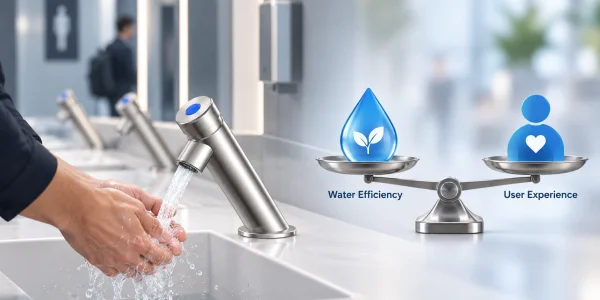
By combining touchless water activation and automatic soap dispensing within a single device, integrated solutions can streamline handwashing workflows while improving space utilization and visual appeal.Touch-free operation is also becoming a defining feature of modern washrooms. Sensor technology allows users to complete the handwashing process with minimal contact, helping facilities meet increasingly stringent hygiene expectations.At the same time, intelligent management capabilities are attracting growing interest. Some advanced systems now offer operating status monitoring, consumable tracking, and maintenance alerts, helping facility managers improve efficiency and reduce downtime.Sustainability is another important driver of innovation. Through optimized sensor controls and water management technologies, modern handwashing fixtures can reduce resource consumption while maintaining reliable performance.Overall, the future of handwashing spaces is expected to become more intelligent, efficient, hygienic, and integrated. Products that successfully balance user experience with operational efficiency will continue to play an increasingly important role across commercial and public facilities.For example, the Bestware integrated soap dispenser sensor faucet features a rapid 0.2-second sensor response and an automatic 24-hour flushing function, helping improve user convenience while supporting waterline hygiene management.
As standards for public facilities continue to rise, washrooms are no longer viewed solely as functional spaces for basic cleaning. They have become an important reflection of facility management quality and service standards.Against this backdrop, fixture integration and functional optimization are emerging as key industry trends. Integrated soap dispenser sensor faucets represent an innovative approach to modern washroom design, offering a combination of convenience, hygiene, and operational efficiency.
By understanding their design, benefits, and application scenarios, facility owners and project planners can make more informed decisions and select solutions that best meet their specific requirements.
One-stop Solution Provider of Stainless Steel Commercial Faucets
Email: business@bestware-stainless.com
after-sales@bestware-stainless.com
Tel: +86 18929047065
WhatsApp: +86 18929047065


WeChat: +86 18929047065


Website: www.bestware-stainless.com(Global Site)
www.bestware-sparkling.com(Water Dispenser)
Add: Block 8, No. 6, Jianda Nan Road, Jiangmen, Guangdong, China
Copyright © Bestware Hardware Production Co., Ltd. All Rights Reserved.
(2).webp)
(1).webp)