Date: 2026-11-12
In commercial kitchens, employees repeatedly pick up spray valves, switch water flow modes, adjust spray direction, and clean cookware, dishes, and work surfaces. Each action may take only a few seconds, but when repeated dozens or even hundreds of times a day, these small time losses can gradually add up and affect overall kitchen efficiency. Unlike obvious equipment failures, such losses are often hidden in routine operations and easily overlooked. For restaurants, hotels, and food processing facilities, reducing unnecessary pauses and repetitive tasks is also an important part of improving kitchen efficiency.
Cleaning tasks in commercial kitchens are highly repetitive. Employees may need to clean multiple batches of dishes, cookware, and food preparation tools in succession. Each task can involve picking up equipment, turning on the water, adjusting the spray direction, and putting the equipment away afterward.
Individually, spending an extra two or three seconds on an action may not seem significant. However, when these actions are repeated dozens or even hundreds of times a day, the accumulated time becomes harder to ignore. For example, if an employee spends an additional five seconds on each cleaning task because the equipment is not easy to operate, and this happens 100 times a day, the total time lost is 500 seconds, or approximately eight minutes. If multiple cleaning stations are involved or more batches need to be handled each day, the accumulated time loss can increase further.
|
Additional Time per Task |
Repetitions per Day |
Total Time Lost |
|
3 seconds |
100 |
5 minutes |
|
5 seconds |
100 |
Approximately 8.3 minutes |
|
10 seconds |
100 |
Approximately 16.7 minutes |
These figures are illustrative calculations rather than actual statistics for all kitchens. The specific time loss depends on the number of cleaning tasks, equipment operation, and workflow at each facility.
It is also worth noting that this lost time does not necessarily mean employees are standing idle. More often, it is scattered across different operations, and employees may not even realize how much time they are losing. However, over an entire shift, these small interruptions can gradually affect the continuity of cleaning tasks.
Kitchen efficiency depends not only on how long employees take to complete individual tasks, but also on how smoothly they move from one operation to the next. For example, after rinsing a batch of dishes, an employee may need to move on to cleaning cookware. If the existing equipment cannot meet the requirements of the next task, they may need to find another tool or change an accessory. Similarly, if the water flow does not provide sufficient coverage, employees may need to repeatedly reposition the spray valve to clean the entire area.
These actions are not particularly complicated, but they can introduce multiple interruptions into an otherwise continuous workflow. Therefore, when evaluating kitchen equipment, it is important to look beyond the time required for a single cleaning task and consider whether the equipment helps reduce unnecessary picking up, switching, adjusting, and repeating.
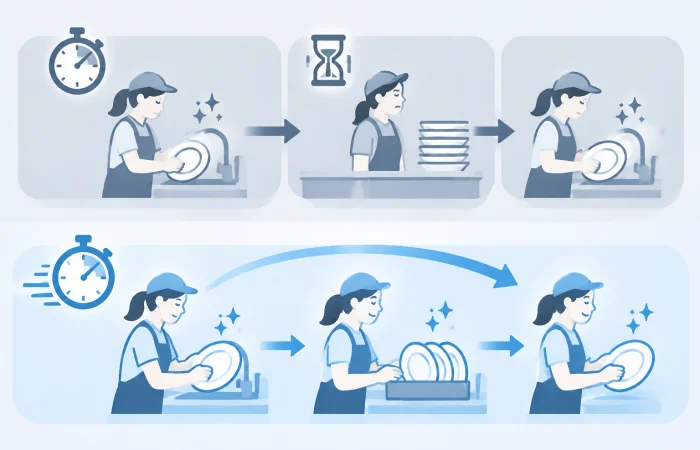
In commercial kitchens, employees typically use different tools for different cleaning tasks. If tools do not have designated storage locations or need to be switched between multiple pieces of equipment, employees spend additional time finding and retrieving them.
This becomes particularly noticeable during busy periods, when employees may need to handle dishes, cookware, and work surfaces one after another. Starting each new cleaning task may involve finding the right tool, picking up the equipment, and putting it away after use. When these actions are repeated many times a day, even a few extra seconds per task can create ongoing time losses.
A well-organized workstation and properly configured equipment are therefore essential. Frequently used tools should be kept within easy reach, while unnecessary equipment changes between cleaning tasks should be minimized. This allows employees to move on to the next operation more quickly.
Different cleaning tasks require different water flow characteristics. For example, stubborn grease on cookware may require a stronger, more concentrated water stream, while dishes and larger work surfaces may benefit from broader water coverage. If a spray valve offers only one water flow mode, employees may need to change the spray nozzle or find another tool to handle different cleaning requirements.
This process may involve removing and installing accessories, as well as pausing the current task to readjust the equipment. For equipment used frequently in commercial kitchens, reducing unnecessary switching is often more valuable than simply shortening the time spent on a single operation. If a spray valve allows employees to switch quickly between different water flow modes, they can handle a wider range of cleaning tasks with the same equipment, reducing interruptions caused by changing tools or accessories.
Insufficient water coverage is another potential source of hidden time loss. When the water flow is concentrated in a small area, employees need to keep moving the spray valve to cover the entire object being cleaned. When handling large cookware, stacked dishes, or work surfaces, uneven water distribution may also leave certain areas insufficiently rinsed. Employees then need to adjust the spray direction and may even have to rinse areas that have already been cleaned.
This shows that cleaning efficiency is not determined by water flow strength alone. Even a powerful water stream can lead to more operating steps if its coverage and distribution are not suited to the task. Therefore, spray valve design should consider not only impact force, but also water outlet angles, coverage, and water flow distribution. This helps employees clean the target area with fewer adjustments.
Repeated rinsing is not always caused by particularly stubborn stains. It may also result from a mismatch between the water flow mode and the cleaning task. For example, when cleaning a large area, limited water coverage may require employees to rinse from several different positions. Uneven water distribution may also mean that certain areas need additional attention. For corners of cookware, dish surfaces, and equipment joints, employees may need to adjust the spray direction according to the specific cleaning requirements.
These additional operations extend the time required to complete each cleaning task. Of course, not all repeated rinsing can be avoided. Different types of residue naturally present different cleaning challenges. However, if repeated operations are mainly caused by insufficient equipment coverage or unsuitable water flow modes, better equipment design may help reduce this unnecessary time loss.
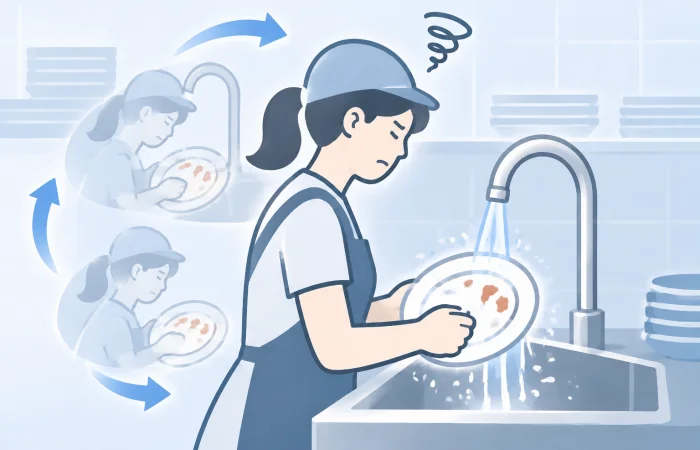
First, cleaning equipment and frequently used tools should be arranged according to the actual workflow in the kitchen. Frequently used tools should be placed within easy reach to prevent employees from repeatedly searching for or carrying equipment between workstations. The arrangement of cleaning areas, draining areas, and items awaiting cleaning should also be considered to minimize unnecessary movement.
For commercial kitchens with limited space, a well-organized workstation not only saves operating time but also helps maintain a tidy working environment and reduces interference between different cleaning tasks.
Equipment versatility directly affects the workflow. If a spray valve can only perform one type of rinsing task, employees may need to prepare additional tools or accessories. In contrast, equipment offering different water flow modes can reduce the need to switch tools when cleaning different objects.
When selecting equipment, purchasers should pay attention to whether the spray valve offers convenient water flow mode switching and whether each mode meets actual cleaning requirements. The goal is not to choose equipment simply because it has more functions, but to ensure that it can handle the cleaning tasks commonly encountered in commercial kitchens.
In actual use, water flow needs to provide both sufficient impact force and appropriate coverage. For large cleaning areas, even water distribution can reduce the need to repeatedly reposition the spray valve. For stubborn stains, sufficient impact force is necessary to remove residue effectively. Therefore, purchasers should evaluate the overall water flow design of a spray valve, including the arrangement of its water outlets, outlet angles, and actual performance in different modes, rather than comparing water pressure alone.
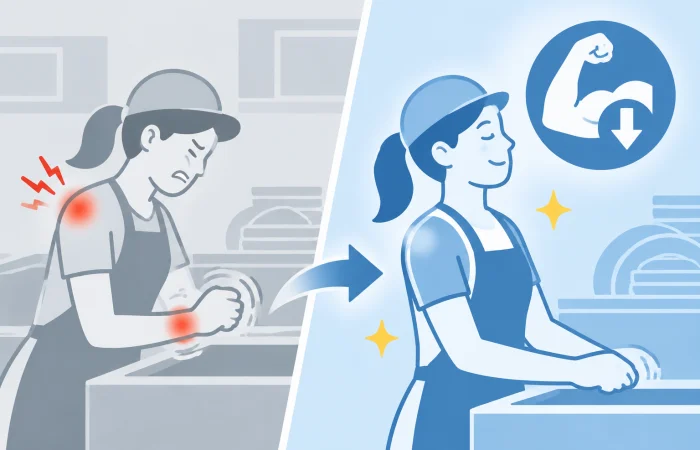
Employees need to hold and operate spray valves repeatedly throughout the day. If the equipment requires considerable operating force, prolonged use can increase physical strain and affect comfort during continuous operation.
Therefore, the handle design, control mechanism, and operating force of a spray valve all deserve attention. In kitchens with intensive cleaning workloads, ease of operation and smooth mode switching can make a difference to employees who perform repetitive tasks.
From a purchasing perspective, in addition to evaluating how easy the equipment is to use, buyers can also check whether suppliers provide relevant test data, such as operating force measurements. This offers a more objective basis for determining whether the equipment is suitable for high-frequency use.
Improving kitchen efficiency often comes down to addressing multiple small details. For commercial kitchens that carry out frequent rinsing tasks, it is important to consider whether a spray valve can handle different cleaning requirements, minimize unnecessary adjustments, and maintain consistent performance over time.
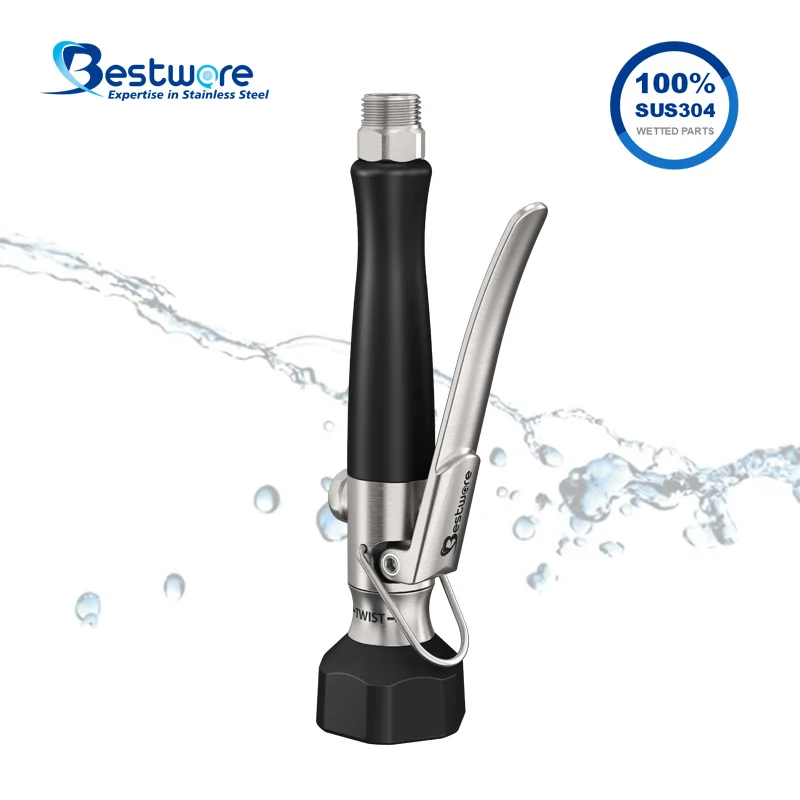
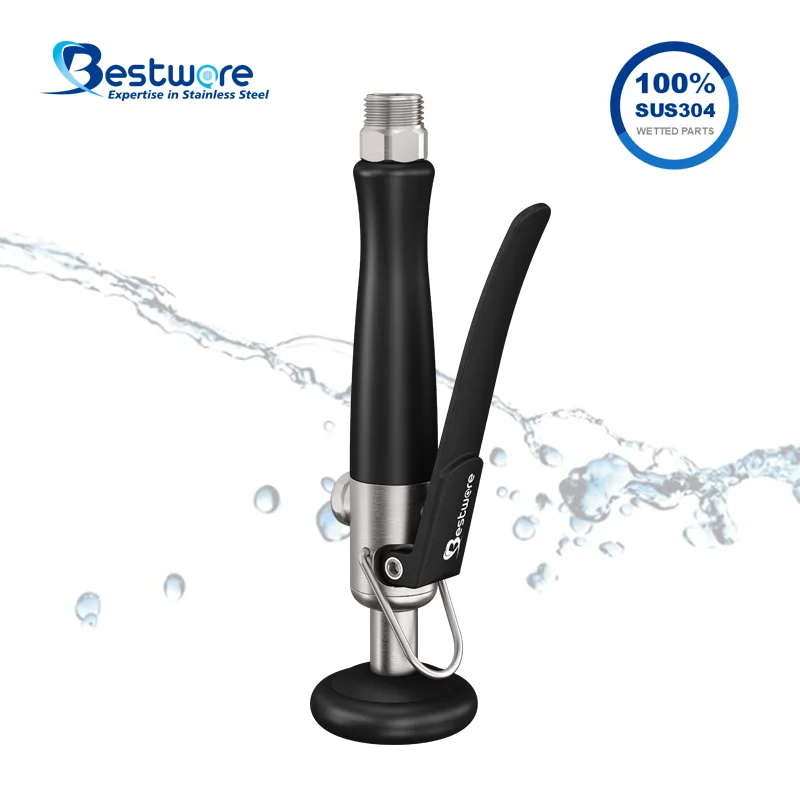
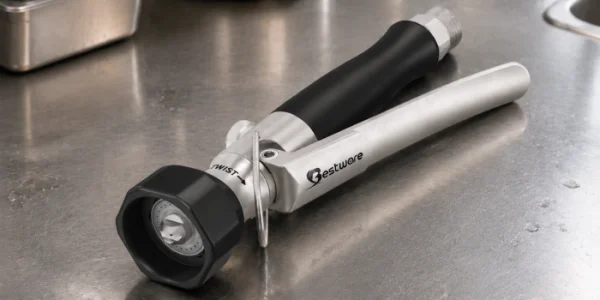
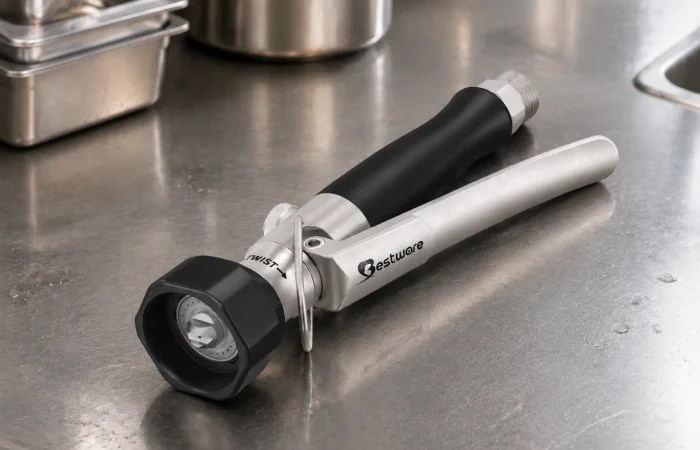
Bestware develops its spray valves around the practical needs of commercial kitchens, optimizing water flow modes, outlet structures, operating effort, and durability. Its patented dual-function spray valve allows users to switch between Powerful Washing and Large-area Washing, helping employees select the appropriate water flow for different cleaning tasks and reducing the need to frequently change tools or spray nozzles. The spray valve also features 24 water outlets, with their angles and heights optimized to improve water flow distribution and coverage. This helps minimize repeated repositioning caused by insufficient rinsing coverage.
For a more comfortable operating experience, Bestware spray valves combine ergonomic design with hydraulic cushioning, reducing the overall operating force required by approximately 75% compared with similar products on the market. This helps ease the burden of prolonged, repetitive operation. In addition, the products have undergone more than 200,000 cycle tests to verify their stability under repeated operation. By addressing water flow switching, rinsing coverage, operating effort, and durability, these design features help reduce unnecessary actions and time losses in everyday kitchen cleaning.
Efficiency losses in commercial kitchens do not always result from obvious equipment failures or complicated operating problems. Sometimes, the few seconds employees spend picking up tools, switching water flow modes, repositioning spray valves, and repeating rinsing tasks can gradually add up over time. Improving kitchen efficiency therefore requires more than simply focusing on how quickly employees work. It also involves reducing unnecessary actions through better equipment selection, workstation layout, and cleaning methods. For commercial spray valves, the ability to handle different cleaning tasks, provide appropriate water coverage, reduce operating effort, and maintain consistent performance over time can all help minimize wasted time in daily operations. A truly efficient kitchen is not just one where every task is completed faster, but one where employees no longer need to repeat actions that could have been avoided in the first place.
One-stop Solution Provider of Stainless Steel Commercial Faucets
Email: business@bestware-stainless.com
after-sales@bestware-stainless.com
Tel: +86 18929047065
WhatsApp: +86 18929047065


WeChat: +86 18929047065


Website: www.bestware-stainless.com(Global Site)
www.bestware-sparkling.com(Water Dispenser)
Add: Block 8, No. 6, Jianda Nan Road, Jiangmen, Guangdong, China
Copyright © Bestware Hardware Production Co., Ltd. All Rights Reserved.