Date: 2026-11-21
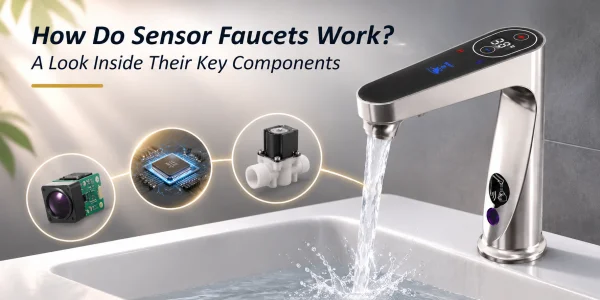
Sensor faucets look similar to conventional faucets, but their internal structures are more complex. Instead of requiring users to operate a handle manually, they use sensors to detect hand movements and a control system to manage water flow. Even a simple water-dispensing process involves several components working together. For buyers, contractors, and everyday users, understanding the key components of sensor faucets helps explain how they work and how each component affects overall performance. For example, the sensor identifies user movements, the solenoid valve controls water flow, and the power supply provides the energy needed to operate the system. This article introduces the main components of sensor faucets, explains their functions, and describes how they work together to deliver water automatically.
Unlike mechanical faucets, which mainly rely on a valve cartridge to control water flow, sensor faucets combine an electronic control system with a waterway structure. Internal designs may vary between models, but the main components generally include the following.
The sensor is essential to the automatic on/off operation of a sensor faucet. It is usually installed near the spout or behind a dedicated sensing window. Many commercial sensor faucets use infrared sensing technology. When a user places their hands within the detection area, the sensor detects changes in the received infrared signals and identifies the presence of an object. It then sends a signal to the control system. Once the user moves their hands away, the sensor detects that the target has left the area, prompting the system to stop the water flow.
Sensor performance directly affects how the faucet responds. If the detection range is too narrow, users may need to repeatedly adjust their hand positions to activate the water. If it is too wide, movements unrelated to normal use may trigger the faucet unintentionally. Therefore, the sensor needs an appropriate level of sensitivity and a detection area suited to the faucet's design and installation environment.
The control circuit acts as the central control unit of a sensor faucet. It receives signals from the sensor and manages the operation of other components according to preset programs. For example, when the sensor detects a user's hand movement, the control circuit determines whether the activation conditions are met and sends an opening command to the solenoid valve. When the hands leave the detection area, the control circuit sends a closing command.
In addition to controlling water flow, the control circuit may also manage functions such as delayed shutoff, maximum flow-time limits, automatic periodic flushing, and low-battery alerts, depending on the product configuration. Therefore, the control circuit affects not only whether the faucet responds correctly but also how well its different functions work together. Even if the sensor accurately detects user movements, an unsuitable control logic may still cause delayed responses or slow shutoff.
The solenoid valve is an important operating component in the waterway system of a sensor faucet. It opens or closes the water supply passage according to control signals. It typically consists of a coil, a valve core, and sealing components. When the control circuit supplies power to the solenoid valve, the coil generates an electromagnetic force that moves the valve core, opening the water passage. When power is cut off, the valve core returns to its original position through the reset mechanism, stopping the water flow.
The performance of the solenoid valve affects both normal water activation and shutoff, as well as long-term operating stability. Factors such as smooth valve-core movement, reliable sealing, and adaptability to water pressure fluctuations are all worth considering. Debris buildup, aging seals, or abnormal valve-core movement may result in changes in water flow, incomplete shutoff, or even a failure to dispense water.
Sensor faucets require electrical power to operate the sensor, control circuit, and solenoid valve. The power supply module is therefore an essential component. The two common power options are battery power and AC power. Battery-powered models generally do not require additional electrical wiring, making them suitable for restrooms where renovation has already been completed and installing new wiring is difficult. AC-powered models are more suitable for projects where power connections have been planned during the design or construction stage.
Different power options have their own advantages. For battery-powered models, buyers should consider battery life, ease of replacement, and low-battery alerts. For AC-powered models, the power specifications, installation location, and electrical connections should be confirmed in advance. Choosing the right power supply can help simplify installation and future maintenance.
The aerator is usually installed at the faucet outlet. By introducing air and mixing it with the water, it helps create a more even stream and regulate the flow pattern. In public restrooms, the aerator affects not only the handwashing experience but also water efficiency and routine maintenance. A suitable aerator can produce a relatively soft and stable stream while helping reduce unnecessary splashing.
However, aerators can be affected by limescale and debris. Over time, clogged internal screens or outlet openings may reduce water flow, cause uneven distribution, or change the direction of the stream. Therefore, the aerator should be inspected and cleaned according to the local water quality and frequency of use.
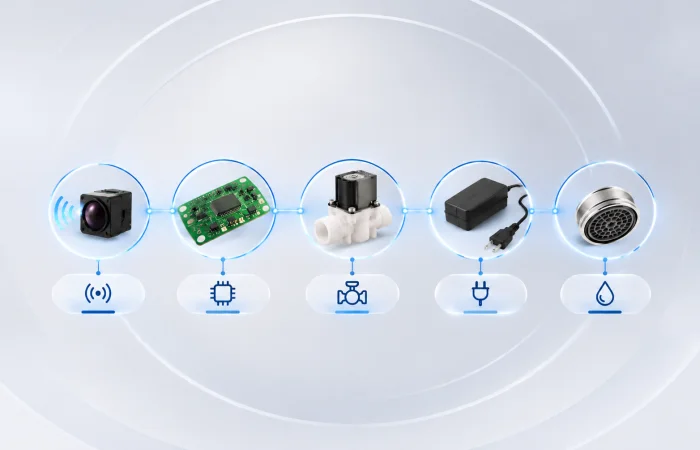
A sensor faucet does not rely on a single component to dispense water automatically. Instead, the process involves several stages, including sensing, signal processing, activation, and water delivery.
The basic operating process can be divided into four steps:
Step 1: The sensor detects a target. When a user places their hands within the detection area, the sensor detects the change and sends a signal to the control circuit.
Step 2: The control circuit processes the signal. The control circuit checks whether the activation conditions are met according to its preset program and sends an opening command to the solenoid valve.
Step 3: The solenoid valve opens the water passage. The valve core moves to open the water supply passage, allowing water to flow through the internal waterway and out of the spout.
Step 4: The sensor detects that the target has left, and the water stops. When the user moves their hands away, the sensor sends a corresponding signal. The control circuit then closes the solenoid valve, stopping the water flow.
The entire process is usually completed within a short time, allowing users to operate the faucet simply by placing their hands within the detection area. It is worth noting that control logic may vary between products. For example, some models have a maximum flow-time limit. Even if a target remains within the detection area, the faucet will automatically shut off once the preset time is reached, helping prevent unnecessary water consumption.
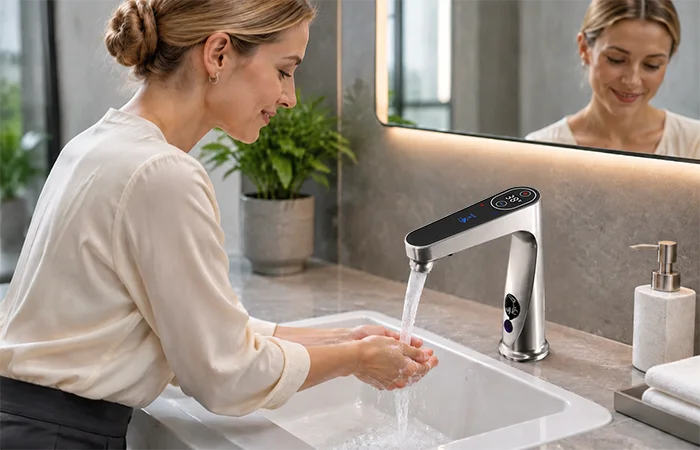
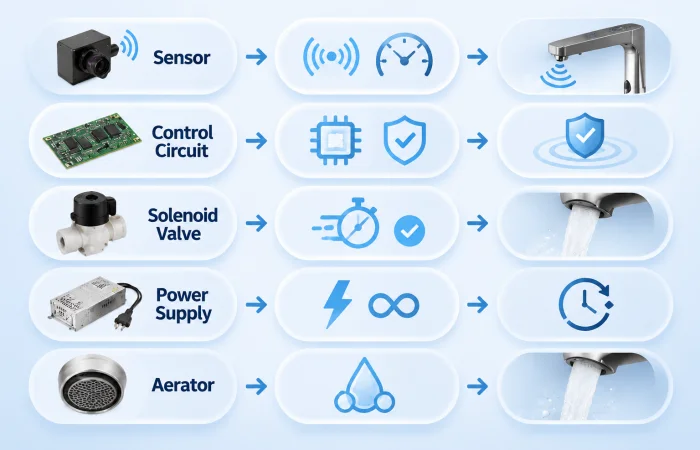
The actual performance of a sensor faucet does not depend solely on sensor sensitivity. It is the result of several components working together. Their coordination is essential to the proper operation of the product.
The sensor detects targets, while the control circuit processes the signals. If the detection area is not properly designed, the faucet may fail to recognize normal handwashing movements accurately. If the control logic is unsuitable, delayed responses or unintended activation may occur. Therefore, evaluating a sensor faucet's response performance requires more than checking sensor sensitivity. Signal processing and control logic must also be considered.
The solenoid valve controls the water passage, but the final water flow is also affected by supply pressure, internal waterway design, and outlet components. For example, when the water supply pressure is insufficient, the flow rate may fall below expectations even if the solenoid valve opens normally. Debris inside the valve or restricted valve-core movement may also cause unstable water flow. Therefore, troubleshooting water flow issues requires checking both the water supply conditions and the valve itself.
Sensors and control circuits require a stable power supply to function properly. Low battery levels or irregular external power may cause slower sensor responses, unstable control functions, or even prevent the faucet from operating. For commercial projects, the power supply option also affects future maintenance arrangements. In facilities with multiple washbasins, planning electrical wiring and battery replacement in advance can help reduce maintenance difficulties later.
Although outlet components such as aerators are not directly involved in electronic control, they affect the final water flow. If they are not cleaned regularly, limescale and debris may gradually accumulate, reducing the flow rate or causing the stream to become uneven. Therefore, maintaining a sensor faucet involves more than checking its sensor and electronic system. The waterway and outlet components also require regular inspection.
In commercial projects, sensor faucets often need to withstand frequent use. Focusing only on appearance, sensing distance, or response speed may not be enough to determine whether a product is suitable for the actual installation environment.
First, buyers should understand the sensor technology and detection area to confirm whether they are suitable for the washbasin layout. The structure and operating stability of the solenoid valve should also be considered, particularly how the product performs under different water supply pressures.
The power supply option should be selected according to project conditions. Battery-powered models may be more convenient where no electrical wiring has been reserved. For projects still in the design or construction stage, an AC power supply can be planned in advance.
In addition, buyers should consider whether waterway components such as aerators are easy to clean and maintain, as well as whether the product offers protection functions suited to the project. For bulk purchasing projects, sample testing before installation is recommended. This allows buyers to evaluate sensor response, activation and shutoff, continuous operation, and actual water flow.
Understanding the functions and relationships of these components helps buyers evaluate a sensor faucet more comprehensively rather than relying on a single specification to judge its overall performance.

In developing commercial sensor faucets, Bestware focuses not only on the performance of individual components but also on the coordination between the sensing system, control system, and waterway structure.
For sensing control, Bestware uses high-sensitivity sensor technology. Selected models offer a response time of up to 0.2 seconds and are equipped with solenoid valves featuring 10 V/m electromagnetic interference resistance to improve operating stability in complex commercial environments.
For hot and cold water models, Bestware integrates sensor control with an intelligent thermostatic system, allowing users to adjust water temperature through a digital panel while helping reduce the impact of water pressure fluctuations on outlet temperature. In addition, selected models feature automatic flushing every 24 hours, running water for 5 seconds after an extended period of inactivity to help address water stagnation in the internal waterways.
These designs are developed around the practical needs of commercial restrooms, helping different components work together to support frequent daily use and maintenance requirements.
A sensor faucet may appear to operate with nothing more than a simple hand movement, but automatic water delivery relies on the coordinated operation of several components, including the sensor, control circuit, solenoid valve, power supply module, and aerator. Each component has a specific role and affects the faucet's overall performance. Understanding these components helps users learn how sensor faucets work and provides useful knowledge for purchasing, installation, and routine maintenance. For commercial projects, the key consideration is not simply the performance of an individual component, but whether all components can work together reliably in the actual operating environment.
One-stop Solution Provider of Stainless Steel Commercial Faucets
Email: business@bestware-stainless.com
after-sales@bestware-stainless.com
Tel: +86 18929047065
WhatsApp: +86 18929047065


WeChat: +86 18929047065


Website: www.bestware-stainless.com(Global Site)
www.bestware-sparkling.com(Water Dispenser)
Add: Block 8, No. 6, Jianda Nan Road, Jiangmen, Guangdong, China
Copyright © Bestware Hardware Production Co., Ltd. All Rights Reserved.