Date: 2026-06-17
Whether in residential kitchens, commercial washrooms, hospitals, airports, or other high-traffic facilities, water temperature safety remains an important concern. Unexpected temperature fluctuations can increase the risk of scalding, particularly in buildings where water pressure and supply temperatures vary throughout the day.Compared with conventional faucets that require users to manually adjust the hot and cold water mix, sensor faucets provide touch-free operation and automatic water delivery. This not only improves hygiene by reducing physical contact but also enhances convenience in everyday use. However, because users rely on the faucet to operate automatically, maintaining a safe and stable water temperature becomes even more critical.For this reason, temperature control is no longer just an additional feature in modern sensor faucets—it is a key factor that directly affects user safety, comfort, and confidence in the product.
The temperature control system of a sensor faucet is built around the mixing of hot and cold water. In today's market, two main approaches are commonly used: mechanical mixing systems and thermostatic temperature control systems.Mechanical mixing systems are the traditional solution. Users preset the desired hot-to-cold water ratio, and the faucet delivers water at a relatively fixed temperature. While this design is simple and cost-effective, changes in water pressure or inlet water temperature can cause noticeable fluctuations in outlet temperature.Thermostatic systems provide a more advanced solution. By combining mechanical components with electronic control technology, they can continuously adjust the hot and cold water flow ratio in real time, helping maintain a more stable water temperature even when supply conditions change.A complete temperature control system typically consists of three key components:The cartridge, which controls water flow and hot-cold water mixing.The control module, which processes data and issues adjustment commands.The sensor, which detects user presence and activates water delivery.Working together, these components create an integrated system capable of delivering both touch-free operation and precise temperature management.
The thermostatic cartridge is the core component of a thermostatic sensor faucet and serves as the first line of defense against temperature fluctuations.Inside the cartridge is a highly sensitive temperature-responsive element that continuously monitors water temperature. When changes occur in the hot or cold water supply—such as variations in temperature or pressure—the sensing element reacts immediately.This response triggers internal components, such as pistons or valve mechanisms, to automatically adjust the amount of hot and cold water entering the mixing chamber. As a result, the system compensates for external changes and maintains a consistent outlet temperature.Modern thermostatic cartridges are designed for rapid response. Temperature corrections are often completed so quickly that users do not notice any change in water temperature, helping prevent the uncomfortable experience of sudden hot or cold water surges.
To minimize the risk of burn injuries, many sensor faucets incorporate multiple layers of anti-scald protection.
|
No. |
Protection Feature |
How It Works |
Safety Benefit |
|
1 |
Maximum Temperature Limit |
A preset temperature threshold restricts the highest allowable outlet temperature through both hardware and software controls |
Prevents excessively hot water from being discharged |
|
2 |
Cold-Water Priority Protection |
The system prioritizes cold water supply and limits hot water flow under abnormal conditions |
Helps reduce the risk of sudden temperature spikes caused by pressure imbalances |
|
3 |
Water Supply Failure Protection |
The faucet continuously monitors hot and cold water supplies and responds immediately if either supply is interrupted |
Automatically shuts off hot water if the cold water supply fails, reducing scalding risks |
Together, these protective measures create a comprehensive safety system that helps safeguard users against unexpected temperature-related hazards.
Temperature control in modern sensor faucets relies on close coordination between the sensing system and the electronic control system.
|
No. |
Function |
Operating Principle |
Benefit |
|
1 |
Independent Yet Connected Modules |
The sensor module and temperature control module operate separately while exchanging data in real time |
Enables fast and synchronized water delivery and temperature control |
|
2 |
Predictive Temperature Adjustment |
The system considers factors such as pipe conditions and water usage duration to make proactive adjustments |
Reduces sudden temperature changes caused by standing water in pipes |
|
3 |
Intelligent Control Chip |
The controller continuously monitors temperature and pressure data and automatically adjusts operating parameters. |
Maintains stable and safe water temperatures without manual intervention. |
By combining sensor detection with intelligent electronic control, the faucet can manage water flow and temperature simultaneously, improving both performance and safety.
In real-world installations, water supply conditions are not always consistent. Municipal water pressure fluctuations and simultaneous water usage in public facilities can significantly affect the balance between hot and cold water supplies.During peak demand periods, for example, multiple fixtures may draw water at the same time, causing sudden pressure changes that can impact temperature stability.To address these challenges, many sensor faucets incorporate pressure-balancing and flow-control components at the water inlet. These devices help stabilize incoming water pressure and reduce the influence of supply fluctuations on water temperature.In addition, advanced systems use closed-loop feedback control. Temperature and pressure data from the outlet are continuously transmitted back to the control unit. If the system detects a deviation from the target temperature range, it automatically adjusts the hot and cold water mix to restore stability.This dynamic adjustment capability allows sensor faucets to maintain consistent performance across a wide range of operating conditions.
Many countries and regions have established regulations that limit the maximum outlet temperature of plumbing fixtures, including sensor faucets. Products must comply with these requirements before entering the market.In sensitive environments such as hospitals, schools, nursing homes, and airports, safety standards are often even stricter. In addition to temperature limits, these facilities may require features such as anti-scald protection, cold-water priority systems, and fail-safe operation during supply interruptions.
Temperature control performance is also commonly evaluated as part of industry certification programs. Products that fail to meet temperature stability or anti-scald requirements may not qualify for certification or commercial procurement projects.As regulations continue to evolve, manufacturers are increasingly focused on improving the safety and reliability of their temperature control systems.
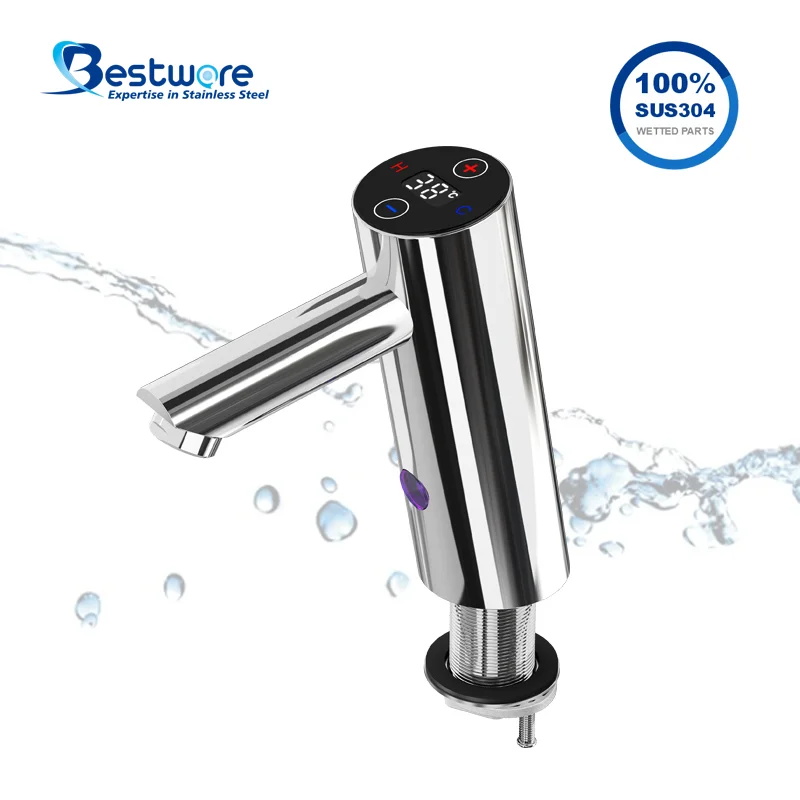
While safety remains the primary goal, modern sensor faucets are also designed to make temperature control easier and more intuitive for users.
|
No. |
Design Feature |
Description |
User Benefit |
|
1 |
Temperature Adjustment Options |
Mechanical knobs, preset temperature settings, or touch controls |
Allows users to select their preferred temperature based on application needs |
|
2 |
Accidental Adjustment Prevention |
Locking mechanisms or protected control areas |
Prevents unintended changes to temperature settings |
|
3 |
Temperature Display |
Digital displays showing real-time water temperature |
Provides clear visual feedback and enhances user confidence |
These user-focused features help create a safer and more comfortable handwashing experience while simplifying daily operation.
As smart sanitary technology continues to advance, temperature control systems in sensor faucets are becoming more intelligent, connected, and precise.One emerging development is AI-assisted adaptive temperature control. By learning user preferences and usage patterns over time, the system can automatically adjust water temperature to match individual needs.Another trend is cloud-based management for commercial facilities. In large environments such as hotels, shopping centers, and office campuses, facility managers can remotely monitor and configure temperature settings for multiple faucets from a centralized platform.At the same time, manufacturers are increasingly focused on balancing safety, comfort, and energy efficiency. Future designs are expected to optimize both hydraulic and electronic systems to reduce energy consumption while maintaining reliable temperature control.

Reliable temperature control is fundamental to the safe operation of sensor faucets. Products that can consistently deliver stable water temperatures while preventing scalding are more likely to earn long-term user trust.Modern temperature control systems are the result of the integration of mechanical engineering, sensor technology, and intelligent electronic controls. From thermostatic cartridges and safety protection mechanisms to advanced control algorithms and real-time monitoring, these technologies work together to create a comprehensive temperature management solution.As safety standards continue to rise and users place greater emphasis on comfort and protection, advanced temperature control technology will remain a key area of innovation and product differentiation in the sensor faucet industry.
One-stop Solution Provider of Stainless Steel Commercial Faucets
Email: business@bestware-stainless.com
after-sales@bestware-stainless.com
Tel: +86 18929047065
WhatsApp: +86 18929047065


WeChat: +86 18929047065


Website: www.bestware-stainless.com(Global Site)
www.bestware-sparkling.com(Water Dispenser)
Add: Block 8, No. 6, Jianda Nan Road, Jiangmen, Guangdong, China
Copyright © Bestware Hardware Production Co., Ltd. All Rights Reserved.
(2).webp)
(1).webp)