Date: 2026-06-15
As sensor faucets are increasingly adopted in public restrooms, healthcare facilities, commercial buildings, and residential projects worldwide, clear differences have emerged in how different regional markets prioritize product functions. These differences are driven by usage habits, climate conditions, regulatory requirements, application scenarios, and consumer expectations.Understanding these regional preferences helps buyers, contractors, and manufacturers select sensor faucet solutions that better fit local market needs.
Long-established hygiene behaviors and usage patterns significantly influence functional requirements for sensor faucets. In Europe and North America, sensor faucets are commonly installed together with separate soap dispensers in public and commercial environments. In contrast, many Asian markets prefer integrated faucet-and-soap solutions due to limited installation space and a stronger preference for compact layouts.Preferences also vary in terms of water flow, soap types, and user interaction methods. Some regions prioritize gentle, water-saving operation, while others focus more on fast and efficient cleaning performance.

Climate conditions strongly affect product configuration needs.Cold regions typically require thermostatic control, anti-freezing protection, and rapid temperature adjustment to improve winter usability. Hot and humid regions place greater emphasis on waterproof performance, corrosion resistance, and long-term operational stability.In dusty environments or areas with inconsistent water quality, anti-clogging designs, built-in filtration systems, and easy-to-clean spouts are increasingly important for maintaining stable performance.

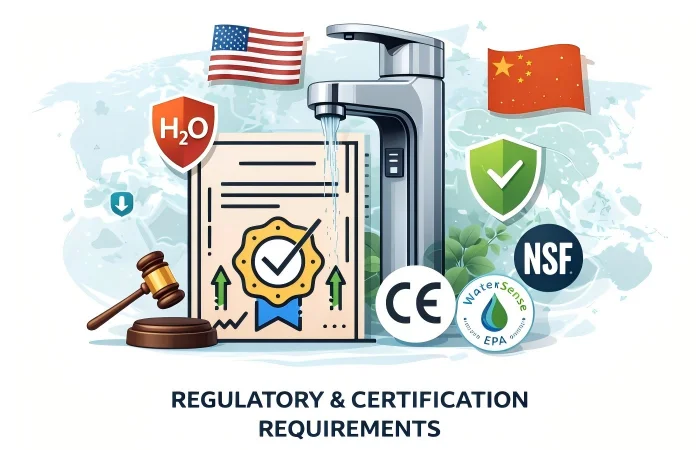
In addition to environmental and usage factors, local regulations and industry standards play a key role in product specification.Many countries enforce strict requirements on water efficiency, material safety, and hygiene performance. These include limits on water flow rate, automatic shut-off timing, and compliance standards for water-contact materials.For export markets, obtaining local certifications is often a mandatory step before product entry. As a result, sensor faucet specifications are frequently adjusted to meet regional compliance requirements.
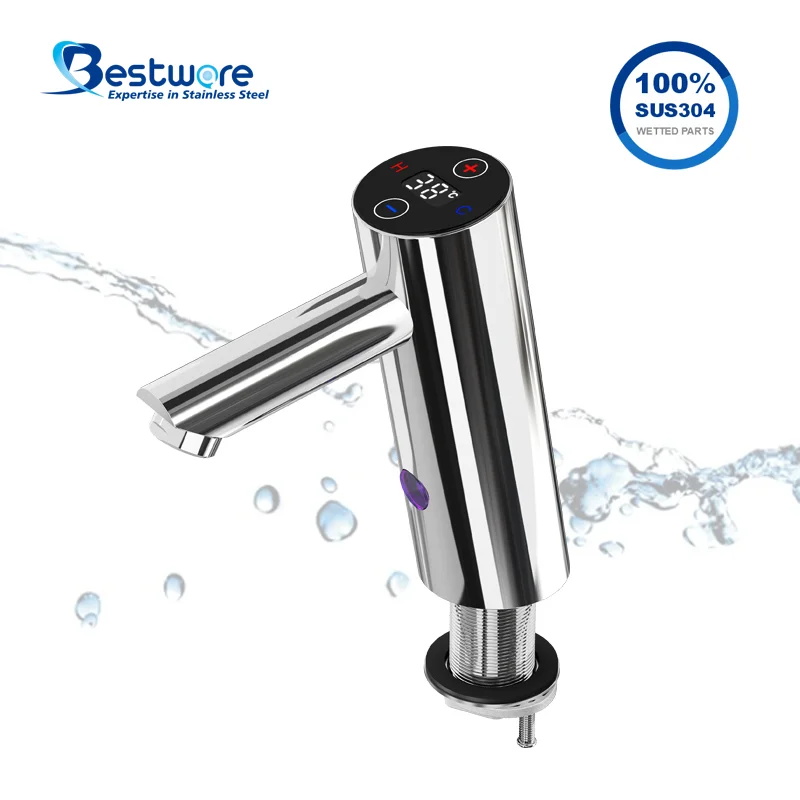
User expectations vary significantly across markets.In developed regions such as Europe and North America, buyers prioritize durability and low maintenance costs. AC-powered systems and long-life sensor modules are commonly preferred to reduce maintenance frequency and operating costs.In emerging markets, users often focus on basic functionality and cost-effectiveness, prioritizing reliable touchless operation over advanced features.In contrast, some Asian markets place higher value on aesthetics, multifunctionality, and smart user experience, including features such as temperature displays, brushed stainless steel finishes, and rechargeable battery systems.
The North American market is dominated by commercial buildings, healthcare facilities, and public infrastructure projects. Procurement decisions are therefore strongly driven by lifecycle cost, regulatory compliance, and maintenance efficiency.Key Selection Criteria:
|
No. |
Category |
Requirement |
Market Expectation |
|
1 |
Water Efficiency |
Flow rate controlled at 0.08–0.12 L/s, equipped with 30-second automatic shut-off |
Meets strict water conservation regulations and reduces long-term operational water costs in high-traffic public spaces |
|
2 |
Certification & Compliance |
Must comply with cUPC, EPA WaterSense and other certifications; water-contact components use SUS304 food-grade stainless steel with low-lead requirements |
Prevents discomfort from cold or excessively hot water |
|
3 |
Sensor Stability |
High resistance to electromagnetic and environmental interference, suitable for high-frequency usage |
Reduces malfunction rate and maintenance downtime in commercial environments |
|
4 |
Maintenance Efficiency |
Modular design with detachable spout and components; easy cleaning structure with scratch-resistant stainless steel finish |
Reduces labor and maintenance costs in North American facility management systems |
Overall, products that combine compliance, durability, water efficiency, and low maintenance cost are more competitive in this market.
Europe places strong emphasis on environmental sustainability and energy efficiency, along with user comfort and product aesthetics.Key Selection Criteria:
|
No. |
Category |
Requirement |
Market Expectation |
|
1 |
Energy Efficiency |
Low-power sensor systems and long battery life supported by energy-saving technologies |
Reduces long-term water and energy consumption costs |
|
2 |
Temperature Control |
Precise thermostatic control between 30–45°C with anti-scald protection |
Prevents discomfort from cold or excessively hot water |
|
3 |
Design Aesthetics |
Minimalist integrated body design with smooth lines and no unnecessary decoration |
Meets high architectural and interior design standards |
|
4 |
Sustainable Materials |
100% recyclable SUS304 stainless steel; compliant with EU REACH and RoHS standards |
Aligns with strict environmental and sustainability requirements |
In Europe, environmental compliance is the baseline requirement, while comfort and design quality determine competitiveness.
The Middle East features extreme heat, desert environments, and a high proportion of premium commercial and residential projects.Key Selection Criteria:
|
No. |
Category |
Requirement |
Market Expectation |
|
1 |
Temperature Safety |
Thermostatic control with fixed temperature protection (e.g., 45°C limit) |
Prevents scalding risks in high-temperature water systems |
|
2 |
High-Temperature Resistance |
Components designed to maintain stable performance under extreme heat conditions |
Ensures reliable operation in harsh desert environments |
|
3 |
Premium Design |
High-polish or brushed stainless steel finishes with integrated modern design |
Enhances architectural and commercial project aesthetics |
|
4 |
Corrosion Resistance |
316 stainless steel or equivalent salt-spray-resistant materials |
Suitable for coastal areas and desalinated water systems |
In Middle Eastern regions, high-temperature environments are common, while commercial complexes, hotels, and high-end residential projects account for a relatively large share of the market. Therefore, in addition to strong environmental adaptability, products are also expected to meet higher requirements in terms of comfort and aesthetic quality.In Middle Eastern regions, high-temperature environments are common, while commercial complexes, hotels, and high-end residential projects account for a relatively large share of the market. Therefore, in addition to strong environmental adaptability, products are also expected to meet higher requirements in terms of comfort and aesthetic quality.
Southeast Asia is characterized by high humidity, coastal salt exposure, and cost-sensitive commercial applications.Key Selection Criteria:
|
No. |
Category |
Requirement |
Market Expectation |
|
1 |
Moisture & Corrosion Resistance |
High-grade waterproof and anti-corrosion housing and internal components |
Ensures long-term operation in humid and coastal environments |
|
2 |
Durability |
Robust sensor and valve structure for frequent daily use |
Reduces maintenance frequency in high-traffic public facilities |
|
3 |
Cost Efficiency |
Integrated basic sensor functions at competitive pricing |
Suitable for budget-conscious projects and small businesses |
|
4 |
Installation & Maintenance |
Simple structure with easy disassembly for cleaning and service |
Reduces operational burden for limited maintenance staff |
Southeast Asian markets prioritize practicality and real-world usability. Environmental adaptability, long-term durability, strong cost-effectiveness, and easy maintenance are the four core criteria when selecting sensor faucets.
In mature markets such as China, Japan, and South Korea, users expect higher standards in hygiene management, smart functionality, and space efficiency.Key Selection Criteria:
|
No. |
Category |
Requirement |
Market Expectation |
|
1 |
Smart Features |
Temperature display, adjustable sensing distance, low battery alerts |
Provides precise and customizable user experience |
|
2 |
Hygiene Control |
Fully touchless design with antibacterial internal components |
Reduces cross-contamination in medical and public environments |
|
3 |
Automatic Flushing |
Periodic water flushing to prevent pipe scaling and soap buildup |
Maintains hygiene and system reliability in high-use locations |
|
4 |
Integrated Design |
Combined water outlet and soap dispensing in a single unit |
Saves space and simplifies installation in compact environments |
Asian consumers in some regions are increasingly shifting toward refined and upgraded preferences. Smart user experience, hygiene protection, self-cleaning pipelines, and space-saving integrated designs have become the mainstream market demand directions.
Despite regional differences, several core functions are widely accepted worldwide:
|
No. |
Feature |
Reason |
|
1 |
Touchless Activation |
Prevents cross-contamination and improves hygiene in all environments |
|
2 |
Water Efficiency Control |
Reduces water consumption and complies with global sustainability trends |
|
3 |
Anti-Scald Protection |
Ensures safety for users of all ages |
|
4 |
Automatic Flushing |
Prevents internal buildup and extends product lifespan |
|
5 |
Integrated Soap Dispensing |
Saves space and simplifies installation in both residential and commercial applications |
|
6 |
Stable Sensor Performance |
Reduces false triggers and improves user experience |
These six core functions align with the shared needs of global consumers and engineering procurement projects, forming the fundamental basis for the widespread adoption of sensor faucets across different regions.By using this standardized configuration as a foundation and integrating region-specific customized features, manufacturers can effectively balance universal applicability with local requirements, thereby enhancing overall product competitiveness in the global market.
Regional differences in sensor faucet requirements are shaped by usage habits, climate conditions, regulatory frameworks, and application scenarios. While functional priorities vary across markets, the global trend is clearly moving toward smarter, more efficient, and more user-friendly solutions.In the future, sensor faucets will continue evolving toward higher intelligence, improved sustainability, and better adaptability, while balancing global standardization with regional customization.
One-stop Solution Provider of Stainless Steel Commercial Faucets
Email: business@bestware-stainless.com
after-sales@bestware-stainless.com
Tel: +86 18929047065
WhatsApp: +86 18929047065


WeChat: +86 18929047065


Website: www.bestware-stainless.com(Global Site)
www.bestware-sparkling.com(Water Dispenser)
Add: Block 8, No. 6, Jianda Nan Road, Jiangmen, Guangdong, China
Copyright © Bestware Hardware Production Co., Ltd. All Rights Reserved.
(2).webp)
(1).webp)