Date: 2026-06-17
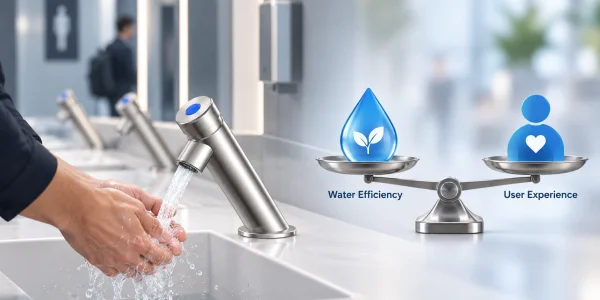
Metering faucets are commonly installed in schools, hospitals, shopping centers, airports, and other public facilities because they automatically shut off after a preset period, helping reduce unnecessary water consumption.When selecting a metering faucet, buyers will generally encounter two options: fixed-time metering faucets and adjustable-time metering faucets. While both are designed to deliver water upon activation and shut off automatically, they differ in terms of flexibility, installation requirements, and application suitability.Understanding these differences can help facility managers, contractors, and project planners choose the most appropriate solution for their specific needs.
A fixed-time metering faucet is designed with a preset flow duration established during manufacturing. Once activated, the faucet supplies water for a fixed period—typically between 5 and 15 seconds, depending on the model—before automatically shutting off.Because the metering time is factory-set, users cannot modify the flow duration after installation.
· Simple internal construction
· Ready for immediate use after installation
· Lower maintenance requirements
· Well suited for standardized public environments
An adjustable-time metering faucet allows the flow duration to be modified through an adjustment screw or built-in regulating mechanism.Depending on the model, the metering time can typically be adjusted within a range of approximately 6 to 16 seconds, allowing the faucet to accommodate different user requirements and facility conditions.
· Adjustable flow duration
· Suitable for a wider range of applications
· Greater flexibility in water-saving management
· Requires on-site adjustment during installation
Although these two faucet types serve different operational needs, they share the same fundamental operating principle. Both rely on a mechanical metering cartridge to control water flow and automatically shut off without requiring electricity.When the push button is pressed, the cartridge opens and allows water to flow. At the same time, an internal spring and damping mechanism begin operating. Once the preset metering period has elapsed, the cartridge gradually returns to its original position, shutting off the water automatically.The primary distinction lies not in the cartridge itself, but in whether the internal damping mechanism can be adjusted.
|
No. |
Type |
Internal Structure |
Operating Principle |
|
1 |
Fixed-Time Metering Faucet |
Fixed damping mechanism |
The cartridge returns at a constant rate, resulting in a fixed metering time. |
|
2 |
Adjustable-Time Metering Faucet |
Adjustable damping mechanism |
The damping force can be modified,changing the cartridge return speed and flow duration. |
Both faucet types provide automatic shut-off and effective water conservation. The key difference is whether the metering time can be adjusted after installation. Fixed-time models offer greater standardization, while adjustable-time models provide increased flexibility for varying operational needs.
Although both products belong to the category of self-closing metering faucets and often look similar externally, they differ in several important areas, including flexibility, installation, maintenance, and overall cost.Understanding these differences can make it easier to determine which solution best matches the requirements of a particular facility.
|
No. |
Comparison Item |
Fixed-Time Metering Faucet |
Adjustable-Time Metering Faucet |
|
1 |
Metering Time |
Fixed |
Adjustable |
|
2 |
Flexibility |
Lower |
Higher |
|
3 |
Internal Structure |
Simpler |
More Complex |
|
4 |
Installation & Setup |
Ready to use |
Requires adjustment |
|
5 |
Maintenance Cost |
Lower |
Slightly Higher |
|
6 |
Initial Purchase Cost |
Lower |
Higher |
In general, fixed-time metering faucets prioritize simplicity, reliability, and cost efficiency, whereas adjustable-time metering faucets focus on adaptability and user-specific requirements. Neither option is universally better; the optimal choice depends on the intended application.
Not every facility requires adjustable metering times. In locations where usage patterns are predictable and user traffic is high, fixed-time metering faucets often provide a cost-effective and reliable water-saving solution.
Handwashing routines in schools are generally consistent and require only a short period of water flow. A fixed metering time is usually sufficient while helping prevent excessive water use.
Facilities such as shopping malls, parks, transit stations, and public buildings serve a large number of users every day. The straightforward design of fixed-time metering faucets helps reduce maintenance demands and long-term operating costs.
Because user turnover is high and water usage habits are relatively uniform, fixed metering times can effectively control overall water consumption and support water-saving goals.
Public-sector projects often place a strong emphasis on reliability, budget control, and long-term maintenance costs. As a result, fixed-time metering faucets are frequently selected for these applications.
For facilities with consistent usage patterns and cost-sensitive maintenance requirements, fixed-time metering faucets offer an effective balance between water conservation, operational simplicity, and long-term value.
In some facilities, water usage requirements vary significantly between different users or operating areas. In these situations, a fixed metering time may not provide the ideal balance between efficiency and user convenience.Adjustable-time metering faucets allow facility managers to tailor water flow duration to specific operational needs.
Healthcare workers and patients often follow more rigorous handwashing procedures. Extending the metering time can reduce repeated activations and improve user convenience.
Laboratory activities may involve equipment rinsing, sample preparation, and other procedures that require varying amounts of water. Adjustable metering times provide greater flexibility across different workstations.
Users frequently need additional time to wash their hands or refill water bottles after physical activity. Longer flow durations can enhance the overall user experience.
Hotels, office buildings, and upscale commercial properties often place greater emphasis on comfort and convenience. Adjustable settings allow facility managers to optimize faucet performance based on actual user needs.
For environments that require both water efficiency and enhanced user comfort, adjustable-time metering faucets offer superior adaptability and are often preferred for specialized or premium applications.
Many buyers assume that an adjustable-time metering faucet is automatically the better option because it offers greater flexibility. However, the need for adjustability should always be evaluated based on actual usage requirements.In facilities where water usage patterns remain consistent over time—such as schools and public restrooms—the adjustment feature may rarely be used after installation. In these cases, the additional purchase and maintenance costs may not provide meaningful benefits.By contrast, hospitals, laboratories, and multi-purpose facilities often have varying operational requirements. Adjustable metering times allow managers to optimize water usage for different applications and improve overall efficiency.It is also important to consider factors such as cartridge quality, durability, and adjustment mechanism reliability. An adjustable faucet may offer additional functionality, but that functionality provides little value if the cartridge wears out prematurely or the adjustment mechanism becomes unreliable.The best metering faucet is not necessarily the one with the most features. Instead, it is the one that best matches the intended application. Fixed-time metering faucets are often sufficient for standardized public facilities, while adjustable-time metering faucets are better suited for environments that require greater operational flexibility.

Choosing between a fixed-time and an adjustable-time metering faucet is ultimately a matter of matching the product to the application. While both solutions are designed to conserve water through automatic shut-off, they address different operational priorities.Fixed-time models offer simplicity, consistency, and cost-effective performance, making them well suited for high-traffic public environments. Adjustable-time models provide greater control and adaptability, allowing facilities to accommodate diverse user needs and operating conditions.By understanding how each type functions and where it performs best, facility managers and project planners can make more informed decisions that support both efficient water management and long-term operational performance.
One-stop Solution Provider of Stainless Steel Commercial Faucets
Email: business@bestware-stainless.com
after-sales@bestware-stainless.com
Tel: +86 18929047065
WhatsApp: +86 18929047065


WeChat: +86 18929047065


Website: www.bestware-stainless.com(Global Site)
www.bestware-sparkling.com(Water Dispenser)
Add: Block 8, No. 6, Jianda Nan Road, Jiangmen, Guangdong, China
Copyright © Bestware Hardware Production Co., Ltd. All Rights Reserved.
(2).webp)
(1).webp)