Date: 2026-07-24
This article is not intended to replace the laws, regulations, or requirements of any country or region, nor does it represent an official interpretation from any certification body. Its purpose is to help purchasers and suppliers better understand certification logic in international projects, establish a more scientific decision-making framework, and provide practical guidance for addressing certification requirements.
In global commercial faucet projects, certification not only affects whether a product can enter a market, but also directly impacts installation approval and project acceptance. However, certification requirements are often more complex than they appear during actual procurement. Purchasers need to determine whether a certification is required by regulations, specified by a project, or simply a preferred qualification. This guide aims to help purchasing managers, distributors, engineering contractors, and brand owners better understand certification requirements and learn how Bestware assists customers in evaluating certification needs, planning certification paths, and reducing compliance risks. It should be noted that certification requirements may vary depending on countries, regions, industry standards, and specific project conditions. The certification logic and solutions discussed in this guide apply to most international commercial faucet projects; however, actual implementation should always follow the latest requirements of local regulations, project documents, and certification bodies.
The core value of certification is to transform a supplier's statements into independently verified evidence of compliance. According to ISO's definition, certification is a process through which an independent organization provides written assurance that a product, service, or management system conforms to specified requirements. In certain industries, certification may even become a legal or contractual requirement.
Therefore, the value of certification is typically reflected in four key areas:
|
Area |
Significance to Customers |
|
Regulatory compliance |
Determines whether products can enter the target market or be legally installed |
|
Project compliance |
Determines whether products can pass bidding review, submittal approval, inspection, and owner acceptance |
|
Risk management |
Reduces risks related to drinking water safety, material compliance, installation rejection, and after-sales disputes |
|
Business confidence |
Enhances distributor confidence and reduces concerns when introducing new products |
For Bestware, certification is not simply a document displayed for reference. It is an important part of project risk management. Our goal is not only to answer “Do we have the certification?”, but to help customers determine: “Is it required? Is it worth pursuing? How should it be planned? And how can it be achieved?”
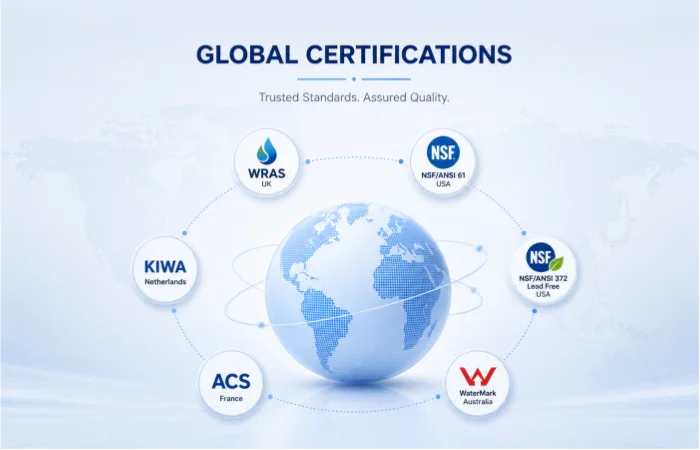
Different markets follow different certification systems. A certification that is essential in one market may not have the same importance in another. Professional purchasing teams should not only look at the certification name itself, but also evaluate whether the certification matches the project market, product model, installation application, and customer specifications.
|
Certification / System |
Main Markets |
Main Focus |
Common Application Scenarios |
|
ISO 9001 |
Global |
Quality management system |
Supplier qualification, factory audits, quality system evaluation |
|
NSF/ANSI/CAN 61 |
North America and some international projects |
Health effects of drinking water system components |
Products in contact with drinking water, public buildings, commercial water supply systems |
|
NSF/ANSI/CAN 372 |
North America and markets requiring lead-free compliance |
Lead content requirements for drinking water contact products |
Lead-free projects, U.S. markets, public drinking water systems |
|
cUPC |
USA and Canada |
Plumbing product safety, performance, and compliance with North American plumbing codes |
North American engineering projects, distribution channels, installation approval |
|
WRAS |
United Kingdom |
Compliance of water fittings with UK water regulations |
UK projects, distributors, public buildings |
|
ACS |
France |
Hygienic compliance of materials and components in contact with drinking water |
Drinking water contact products in France |
|
DVGW |
Germany |
German technical rules for water and gas industries, product and system certification |
German engineering projects, distribution channels, installation requirements |
|
WaterMark |
Australia |
Mandatory certification for plumbing and drainage products |
Australian installation projects |
|
WELS |
Australia / New Zealand and other markets |
Water efficiency labeling |
Water-saving faucets, shower products, public water efficiency projects |
This table highlights an important fact: Certification is not a single universal qualification. Instead, it is a compliance system determined by market requirements, regulations, product categories, and project specifications.
Many purchasers may have a reasonable question: “If you are a professional manufacturer, why do you not have this specific certification?”
This question requires a more comprehensive understanding.
Not having a particular certification does not necessarily mean that a manufacturer lacks capability, nor does it mean that the product is unreliable. A more accurate explanation is that the manufacturer's historical markets, product portfolio, and customer project requirements may not have created a continuous demand for that specific certification.
Global certification systems generally have four key characteristics:
Different markets focus on different certification requirements.
For example:
· Projects in the United States may require cUPC, NSF/ANSI/CAN 61, and NSF/ANSI/CAN 372.
· Projects in the United Kingdom may focus on WRAS
· Installation projects in Australia may require WaterMark
· Projects in France may require ACS
· Projects in Germany may require DVGW
Having ISO 9001 does not mean that all product models automatically have NSF/ANSI/CAN 61 or cUPC certification. Similarly, certification for one product series does not necessarily cover all specifications, materials, manufacturing locations, structural changes, or customized models. Certification coverage must always be evaluated based on the specific certified products and applicable scope.
Certification usually involves multiple stages, including testing, audits, documentation preparation, sample submission, corrective actions, annual fees, and ongoing maintenance. Certification is not a one-time submission process. It is a compliance asset that requires long-term management and investment.
No manufacturer can realistically obtain every certification required by dozens of countries and regions in advance without clear market demand. A more practical approach is to establish certification coverage for markets with stable and ongoing demand, while evaluating certification investment based on new markets, new customers, and new projects.
Bestware does not answer customers' certification questions simply by saying “whether we have the certification or not.” Instead, we focus on whether the certification is necessary for the current project, whether the investment is worthwhile, and if required, how it should be planned, implemented, and supported through a reasonable project investment approach.
When customers see certification costs, they may assume that they are simply paying for a certificate. In reality, certification is a complete project involving multiple technical, administrative, and compliance activities. Taking NSF/ANSI/CAN 61 as an example, the certification process generally involves application submission, documentation review, technical evaluation, factory assessment, laboratory testing, and ongoing certification maintenance. WRAS certification also involves strict testing through approved laboratories.
Certification costs usually include the following components:
|
Cost Category |
Details |
Why It Is Required |
|
Regulation and standard analysis |
Review of target market regulations, project documents, customer specifications, and applicable standards |
To determine which certification is actually required |
|
Technical documentation preparation |
Drawings, BOM, material lists, manuals, product applications, production information |
Certification bodies need to evaluate product structure and materials |
|
Samples and logistics |
Sample preparation, shipping, customs clearance, backup samples |
Physical samples are required for laboratory testing |
|
Laboratory testing |
Material testing, performance testing, sanitary testing, lead content testing, etc. |
To verify compliance with applicable standards |
|
Factory audit |
Production site inspection, quality system review, sample selection |
To confirm consistency between mass production and tested products |
|
Corrective actions and retesting |
Structural adjustments, material changes, process modifications, additional testing |
Required if the initial evaluation identifies non-conformities |
|
Certification application and approval |
Application fees, audit fees, certification fees, listing fees |
To obtain official certification records and documentation |
|
Annual maintenance |
Renewal fees, surveillance audits, certificate updates, change management |
Certifications require ongoing maintenance |
|
Internal project management |
Communication between engineering, quality, sales, purchasing, and certification bodies |
Certification requires cross-functional coordination |
Therefore, certification cost is not a single fee, but a complete project investment. This is why, when Bestware receives a request for a specific certification, we do not immediately start the certification process based solely on the customer's request. Instead, we first conduct a project evaluation and then provide a suitable certification recommendation.

When customers consult Bestware about a specific certification, we do not simply answer “yes” or “no.”
A new certification should be evaluated from three perspectives:
1. Actual project requirements
2. Technical feasibility
3. Commercial value
Whether a new certification should be pursued depends not only on the customer's request, but also on whether the certification is truly necessary, whether implementation is feasible, and whether it creates long-term value for both parties.
Bestware typically evaluates certification requirements based on the following factors and discusses the most suitable solution with customers:
|
Evaluation Factor |
Not Recommended Immediately |
Can Be Evaluated |
Recommended Priority |
|
Regulatory necessity |
Not required by regulations, only preferred by the customer |
Mentioned in project documents but alternative solutions exist |
Clearly required by regulations or installation approval |
|
Order value |
Small one-time order |
Medium volume with potential repeat purchases |
Large projects or annual purchasing agreements |
|
Market reusability |
Only applicable to one customer or one project |
Applicable to some customers or products |
Opens a new country or regional market |
|
Timeline feasibility |
Project schedule cannot accommodate certification lead time |
Delivery schedule can be adjusted |
Customer can support the certification timeline |
For Bestware, if a certification only serves a low-value, low-repeat project without a long-term cooperation foundation, we generally recommend customers consider existing certified solutions or alternative approaches rather than immediately starting a new certification process. On the other hand, if the certification can help customers enter a target market, satisfy project compliance requirements, and provide long-term reuse value (for example, covering multiple models or customers), Bestware will actively discuss the certification implementation plan with customers and establish a practical project roadmap.
When a customer project involves specific certification requirements, Bestware can provide support in the following areas:
|
Stage |
Bestware Support |
|
Requirement confirmation |
Assist customers in confirming the target market, project application, product models, and certification requirements |
|
Existing certification review |
Verify whether Bestware's existing certifications, including ISO 9001, NSF/ANSI/CAN 61, NSF/ANSI/CAN 372, and cUPC, are applicable to the project |
|
Technical documentation support |
Provide technical documents such as drawings, specifications, material information, product structure details, and testing records |
|
Sample coordination |
Assist in preparing certification testing samples according to certification body requirements and project conditions. Related costs and arrangements shall be confirmed separately based on the specific project |
|
Technical pre-assessment |
Evaluate whether the product structure, materials, and manufacturing processes may meet certification requirements |
|
Improvement coordination |
If product adjustments are required during certification testing or audits, Bestware can provide technical communication and improvement suggestions based on actual project conditions |
|
Existing certification maintenance |
Maintain Bestware's existing certifications, including certificate updates, model management, and related documentation |
Bestware's value is not only reflected in the certifications we currently hold, but also in our ability to help customers better understand certification requirements and develop a clear and practical project approach. For purchasers, this means more efficient communication, clearer responsibility boundaries, and better control of compliance risks.
1. If my project requires a certification that Bestware does not currently have, what should we do?
We will first confirm your project location, product model, installation application, and project documentation requirements. Since certifications are usually related to specific markets, product models, and application scenarios, we need to evaluate these details before determining whether Bestware's existing certifications are applicable or whether a new certification pathway needs to be planned.
2. What basic certifications does Bestware currently have?
Bestware currently holds ISO 9001 Quality Management System Certification, as well as NSF/ANSI/CAN 61, NSF/ANSI/CAN 372, and cUPC certifications. The applicability of these certifications still needs to be verified based on the specific product models and project requirements.
3. If Bestware does not currently have a certain certification, does it mean the product does not meet the requirements?
Not necessarily. Different certifications usually correspond to different countries, markets, and project requirements. Bestware currently holds ISO 9001 Quality Management System Certification, NSF/ANSI/CAN 61, NSF/ANSI/CAN 372, and cUPC certifications. For new certification requirements, we will evaluate the target market, product models, and project specifications to determine whether existing certifications are applicable or whether a new certification pathway needs to be planned.
4. Why are certification costs so high?
Certification costs usually include more than just the certification fee. They may also involve standard analysis, documentation preparation, samples, testing, audits, corrective actions, retesting, certification issuance, and annual maintenance. The actual cost will vary depending on the certification type, product scope, testing requirements, and certification body requirements.
5. Why can't certification be completed quickly?
Certification requires third-party organizations to conduct documentation reviews, sample testing, factory or system audits, and technical evaluations. If issues related to materials, product structure, or documentation are identified during the process, corrective actions and retesting may also be required. Therefore, certification should be planned according to the actual project timeline and cannot be treated as a simple administrative procedure.

Certification is not simply a document displayed for reference. It is an important part of project compliance, procurement risk management, and long-term cooperation. When customers require specific certifications, Bestware's approach is not to avoid the requirement or make unrealistic commitments. Instead, we work together with customers to understand the actual project needs, evaluate whether existing certifications are applicable, and develop suitable solutions based on technical feasibility, certification timelines, project value, and cooperation models. Bestware believes that a professional supplier should not only answer “Do we have the certification?” More importantly, a professional supplier should help customers understand: “What certification does this project require? Is it worth pursuing? How should it be implemented? And how can risks be controlled?” This is the core value of the Bestware Project Certification Solution Guide.
One-stop Solution Provider of Stainless Steel Commercial Faucets
Email: business@bestware-stainless.com
after-sales@bestware-stainless.com
Tel: +86 18929047065
WhatsApp: +86 18929047065


WeChat: +86 18929047065


Website: www.bestware-stainless.com(Global Site)
www.bestware-sparkling.com(Water Dispenser)
Add: Block 8, No. 6, Jianda Nan Road, Jiangmen, Guangdong, China
Copyright © Bestware Hardware Production Co., Ltd. All Rights Reserved.
(2).webp)
(1).webp)