Date: 2026-11-17
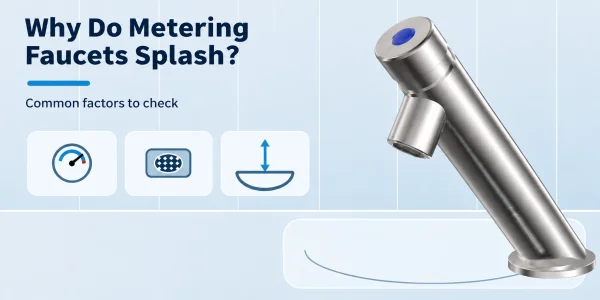
In public restrooms, schools, hospitals, and commercial facilities, metering faucets are often subject to frequent use. Ideally, water should flow evenly after activation and shut off automatically after a preset time. However, the stream may sometimes become too strong, splash outward, or change direction. These issues affect user experience and increase cleaning and maintenance work. The cause is not necessarily a faulty valve cartridge. Water pressure fluctuations, an unsuitable flow rate, a clogged aerator, or improper installation can all affect water flow. Understanding these factors is the first step toward identifying and resolving the problem.
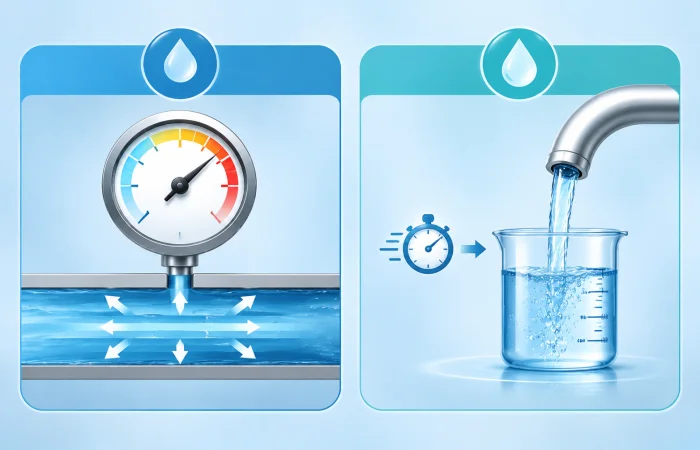
Water pressure is the force that drives water through pipes and faucets, while flow rate refers to the volume of water delivered per unit of time. Although closely related, they are not interchangeable.
Inside a faucet, water passes through the valve cartridge, internal flow passages, flow restrictors, and outlet components. When the supply pressure changes, the flow conditions through these components may also change. For outlet designs without pressure-compensating capabilities, higher pressure generally results in a higher flow rate, while lower pressure may weaken the water flow. For example, the same faucet installed in different buildings or on different floors may deliver different water flow performance, even when the product model and outlet components are identical. This is because water supply pressure conditions vary between buildings.
The U.S. Environmental Protection Agency (EPA), in its water management guidance for commercial facilities, recommends checking whether system water pressure is within approximately 20–80 psi (138–552 kPa) when evaluating faucet performance. This range can serve as a reference for system inspections, but actual installation conditions should be assessed based on the manufacturer's product requirements and the site's water supply conditions.
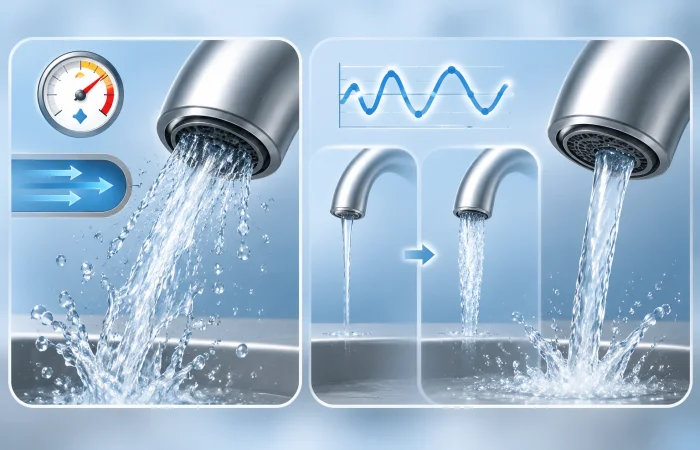
When the supply pressure exceeds the faucet's applicable operating range, water may flow out of the outlet at a higher velocity. If the flow rate is not suited to the basin's size, depth, or drainage area, the water may splash outward when it strikes the bottom or sides of the basin.
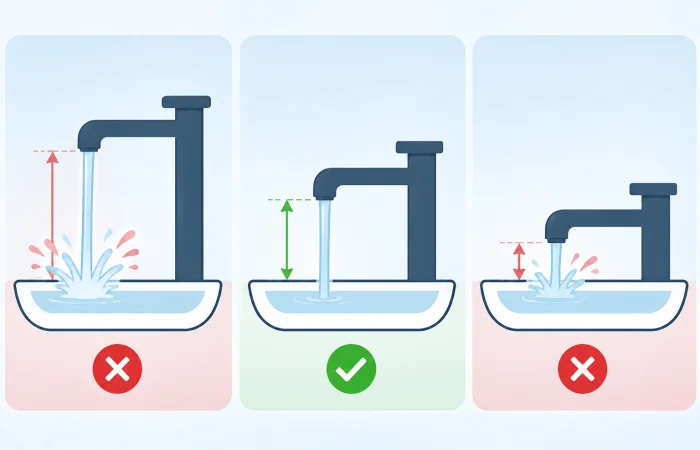
This is particularly noticeable when the spout is installed at a greater height, the basin is relatively shallow, or the water flow is concentrated in a small area. Water falling from a greater height can gain more impact velocity. If the stream is also concentrated, it may rebound noticeably when it hits the basin surface.
Therefore, splashing does not necessarily mean that the faucet is delivering an unusually high volume of water. Even without a significant increase in flow rate, changes in spout height, angle, or water flow pattern can affect where the water lands and how much it rebounds.
Water pressure in commercial buildings does not always remain constant. Peak water demand, the simultaneous operation of other equipment, and differences in water supply between floors can all affect local supply conditions.
When pressure changes over a short period, the faucet's flow rate and water flow pattern may also change. Users may notice that the same faucet delivers a gentle stream at certain times but a noticeably stronger stream at others. The flow may also fluctuate or become unstable in direction.
It is important to distinguish pressure fluctuations from transient pressure surges in pipes. The former may involve changes in supply conditions over a period of time, while the latter may be associated with operations such as the rapid opening or closing of valves. When diagnosing the problem, consider when it occurs, how other water outlets perform, and the results of on-site pressure measurements. A single splashing incident is not enough to confirm that water pressure is the cause.
If the water supply pressure is relatively stable but the faucet still produces an abnormal stream, the outlet components and installation conditions should be checked.
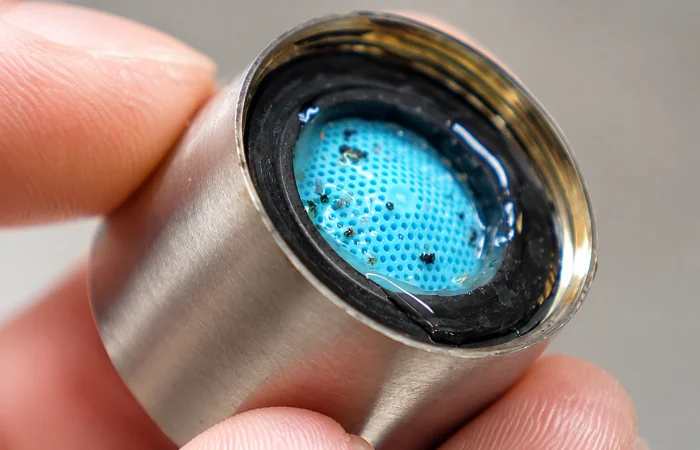
An aerator is usually installed at the faucet outlet. Its internal screens or flow-straightening components help produce a more uniform stream. Over time, limescale, sand, and pipe debris may accumulate inside the aerator, blocking some of its openings. When water cannot pass through evenly, the stream may split, become misdirected, or flow intermittently. For example, water that should flow straight downward may suddenly spray to one side. If only one faucet has this problem while other faucets in the same area operate normally, the aerator should be one of the first components to inspect. If cleaning does not restore normal flow, or if the screen is deformed or damaged, the component should be replaced with a suitable one.
A higher flow rate is not always better. In public handwashing areas, faucets need to provide enough water for normal handwashing while avoiding excessive flow that may cause splashing. Different outlet designs produce different water flow patterns. For example, a conventional aerated stream mixes air with water to create a softer flow, while a laminar outlet produces a relatively clear and continuous stream. A spray outlet distributes water through multiple openings. Each design serves different needs, but the actual water pressure, flow rate, and basin conditions must all be considered when selecting an outlet. This shows why water-saving design should not be evaluated by flow rate alone. The water flow must also be tested to ensure that it is suitable for the actual installation environment.
The spout height, outlet angle, basin depth, and point where the water lands all affect the final user experience. If the outlet is positioned too high above the basin, the impact of the water against the basin surface may increase. If the outlet is too close to the basin rim, the stream may miss the effective washing area. If the basin is too shallow, splashing may occur even when the flow rate is appropriate. Therefore, when designing a new project or replacing equipment, the faucet and basin should be evaluated as a complete combination rather than determining compatibility based on faucet dimensions alone.
When splashing occurs, there is no need to replace the entire faucet immediately. A step-by-step inspection, starting with external components and moving inward, can help narrow down the cause.
Different symptoms can help determine where to start troubleshooting:
· Splashing occurs every time the faucet is activated: Check the outlet components, flow rate settings, and the compatibility between the faucet and basin.
· Splashing occurs more frequently during peak water demand: Check for pressure changes in the water supply system when multiple outlets are in use.
· The water stream suddenly shifts to one side: Check whether the aerator is clogged, misaligned, or damaged.
· Splashing begins after maintenance or installation: Check whether the pipes have been flushed and whether the internal components are correctly installed.
· Multiple faucets in the same area develop the same issue: Investigate the shared water supply system.
These symptoms provide initial troubleshooting directions but cannot replace an on-site inspection.
After shutting off the water supply, remove any serviceable outlet components according to the product instructions and check for limescale, sand, or other debris. During cleaning, avoid damaging the screen or seals, and reinstall the components in their original order.
If the problem persists, use a pressure gauge to measure both static and dynamic water pressure. Static pressure is measured when all water outlets are closed, while dynamic pressure is measured when a faucet or other water outlet is operating.
Normal static pressure does not necessarily mean that the supply will remain stable when multiple outlets are used simultaneously. If dynamic pressure fluctuates significantly, the supply pipes, pressure-reducing valve, and pump operation should also be checked.
After completing the previous checks, observe whether the water stream lands within the effective area of the basin, whether it directly strikes the bottom or sides, and whether it is likely to splash outside the basin during normal handwashing.
If both the water pressure and outlet components are normal but noticeable splashing continues, the issue may be caused by a mismatch between the faucet and basin. In this case, consider adjusting the installation position or choosing a spout height, angle, and water flow pattern that better suit the basin design.
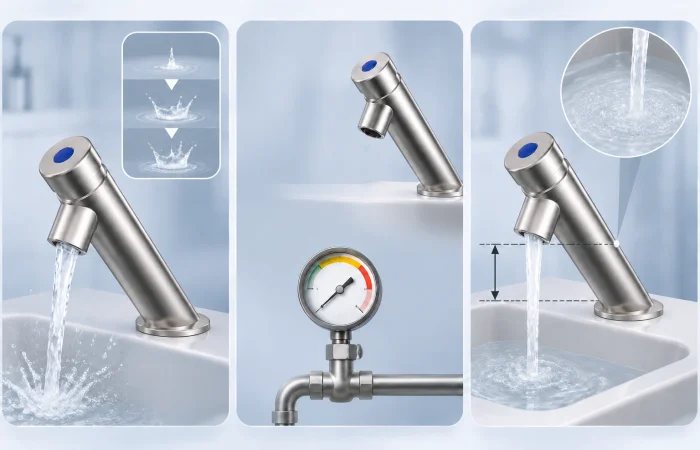
Reducing splashing requires more than controlling the flow duration. Metering faucets must also account for water supply conditions, flow rate control, outlet design, and long-term performance.
An excessively high flow rate may increase water impact and splashing, while an excessively low flow rate may make normal handwashing difficult and cause users to reactivate the faucet repeatedly. Therefore, the product should be fitted with an appropriate flow rate and outlet components based on its intended application, with water flow tested under different supply conditions.
When water pressure in a building fluctuates, pressure-balancing or pressure-compensating design can help reduce the impact of pressure changes on water flow performance, allowing the faucet to maintain a relatively stable flow rate within a certain range. However, this does not mean that the faucet can operate under any water supply conditions. The product must still be used within the operating pressure range specified by the manufacturer. Abnormal site pressure conditions should also be addressed at the water supply system level.
Well-designed internal flow passages and outlet openings help reduce uneven distribution, stream deviation, and localized impact, resulting in more uniform water flow. At the same time, the valve cartridge, seals, and internal filtration components must be reliable to minimize the impact of debris accumulation and component wear on long-term flow performance. For public facilities, the ease of cleaning and replacing outlet components is also an important consideration in routine maintenance.
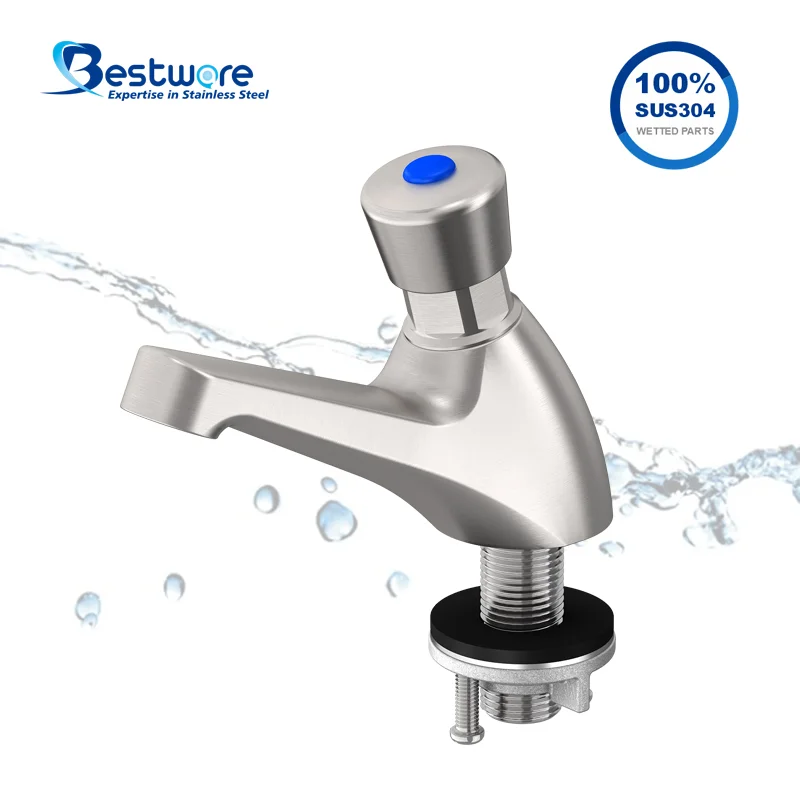
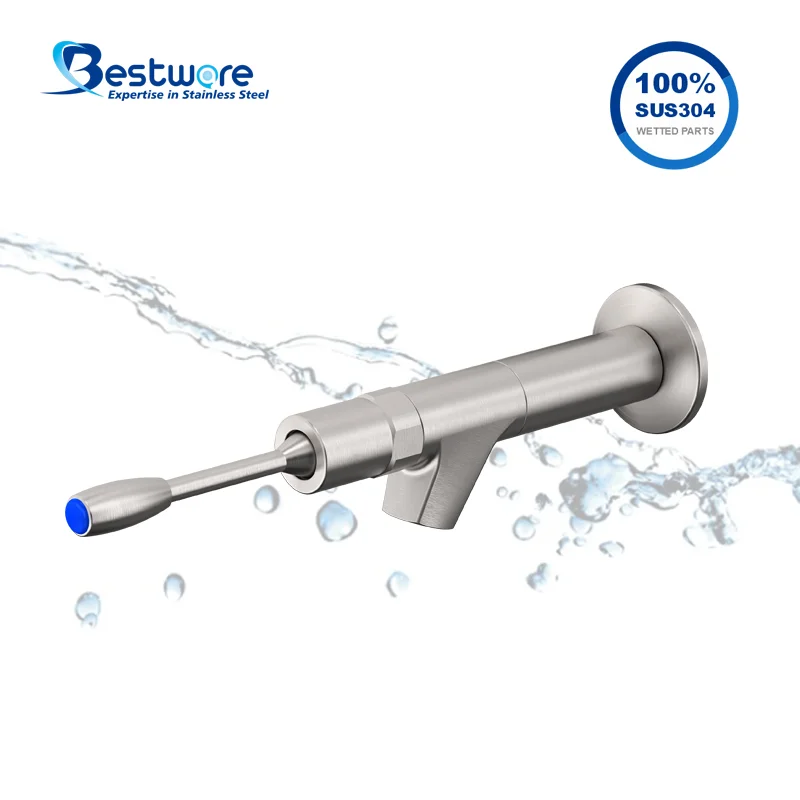
Bestware specializes in stainless steel commercial faucets, providing metering faucet solutions for public restrooms, schools, hospitals, and other commercial facilities. In high-frequency-use environments, products need to do more than shut off automatically after a preset time. They must also deliver appropriate operating force, flow rate, and long-term performance stability.
In its metering faucet designs, Bestware focuses on the coordination of valve control, internal filtration, and water flow performance. The easy-press design reduces the force required to activate the water, while the pressure-balancing design helps accommodate water supply pressure changes within a certain range. Together, these features help maintain a relatively stable and gentle water flow, reducing inconvenience caused by inconsistent flow.
In addition, Bestware uses food-grade 304 stainless steel as its primary material and considers structural stability under long-term, high-frequency use. For purchasers and project engineers, selecting a metering faucet requires more than comparing materials and automatic shutoff times. On-site water pressure, basin design, actual water flow performance, and maintenance conditions should also be evaluated.
Splashing in metering faucets may result from excessive water pressure, pressure fluctuations, clogged outlet components, an unsuitable flow rate, or improper installation. To identify the cause, first observe when and how the splashing occurs, then inspect the outlet components and measure the water pressure. Finally, evaluate the actual water flow in relation to the basin design. For public restrooms and commercial facilities, stable water flow affects not only the user experience but also water efficiency and routine maintenance. A reliable metering faucet should deliver an even, gentle stream under different operating conditions and maintain consistent performance over years of frequent use.
One-stop Solution Provider of Stainless Steel Commercial Faucets
Email: business@bestware-stainless.com
after-sales@bestware-stainless.com
Tel: +86 18929047065
WhatsApp: +86 18929047065


WeChat: +86 18929047065


Website: www.bestware-stainless.com(Global Site)
www.bestware-sparkling.com(Water Dispenser)
Add: Block 8, No. 6, Jianda Nan Road, Jiangmen, Guangdong, China
Copyright © Bestware Hardware Production Co., Ltd. All Rights Reserved.