Date: 2026-10-14
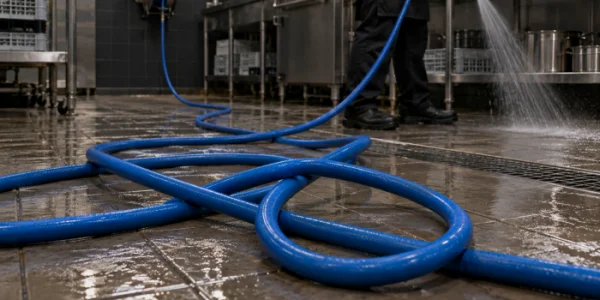
In commercial cleaning environments such as restaurant kitchens, hotel kitchens, and food processing facilities, hose reels are frequently used to clean floors, rinse equipment, and remove stubborn dirt. After a period of use, however, some hoses may begin to twist, tangle, or retract unevenly. Operators have to stop and untangle the hose, which not only slows down cleaning but may also accelerate hose wear. When these problems occur, people often inspect the hose itself while overlooking another key factor: the reel design. Smooth hose extension, orderly winding, and reliable retraction depend not only on the hose material and flexibility but also on the reel structure, retraction system, and installation position. When purchasing a commercial hose reel, buyers should therefore look beyond hose length and spray gun functionality and pay attention to how the reel performs in everyday use.
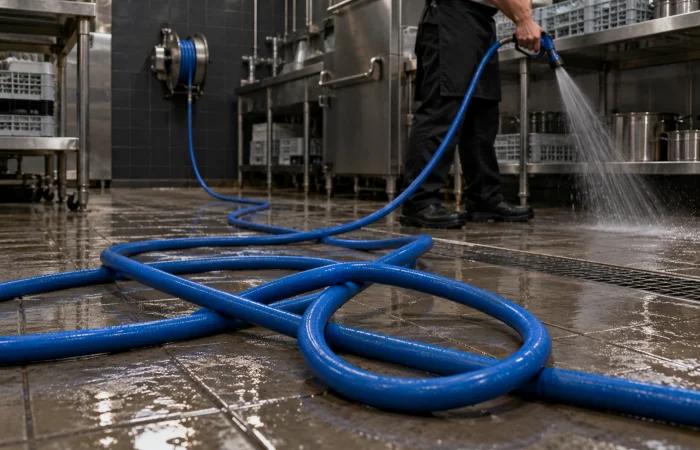
A tangled hose does not necessarily indicate a quality problem with the hose itself. In commercial settings where hose reels are used frequently, the hose constantly changes position and direction as it is pulled out, redirected, and retracted. If it does not follow a consistent path during retraction, it may overlap or become tangled on the reel, making subsequent operation more difficult.
For example, an operator may pull out the hose, guide it around a worktable to clean underneath equipment, and then pull it from another direction. These repeated changes in direction subject the hose to pulling forces from different angles. If the hose does not return to the reel along a suitable path, sections may overlap or accumulate unevenly, increasing resistance the next time the hose is pulled out.
A mismatch between hose length and the cleaning area can also make operation more difficult. If the hose is too long, the excess length may drag across the floor, where it can be stepped on, pulled, or crushed. If it is too short, operators may pull it excessively to reach distant areas, placing additional tension on the hose and reel.
Hose tangling is therefore rarely caused by a single factor. Reel design affects how the hose is arranged, the retraction system influences how it is wound back, and the hose's own properties and the surrounding layout also affect performance. To address the problem, it is important to identify where the hose encounters resistance or loses its proper path.
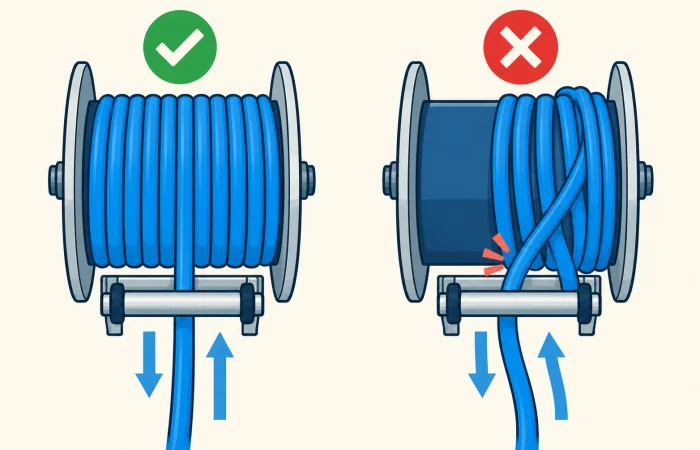
A reel does more than store a hose. It should also help the hose maintain an orderly arrangement as it is repeatedly extended and retracted. The design directly affects the hose's movement, the resistance encountered during extension, and the ease of retraction.
First, consider how the hose is arranged on the reel. Without suitable guidance, the hose may accumulate on one side or overlap unevenly during retraction. Over time, this irregular winding can increase friction and compression between sections of the hose, making it harder to pull out again.
Second, the space inside the reel must be suitable for the hose's diameter, length, and bending characteristics. An unsuitable internal layout may cause the hose to become compressed or prevent it from winding consistently during retraction. However, a larger reel is not necessarily better. What matters is whether the internal structure accommodates the hose's movement and allows it to be stored smoothly within the available space.
The hose outlet position is equally important. The hose typically passes through a designated opening when being pulled out. If this outlet does not align well with the hose's direction of movement, operators may encounter noticeable resistance or need to reposition the hose repeatedly when changing cleaning directions. Over time, this can increase operator effort and cause additional friction between the hose and the reel's edges.
When evaluating reel design, buyers should look beyond whether the reel can accommodate a sufficiently long hose. Three practical factors deserve attention: whether the hose pulls out smoothly, whether it winds back in an orderly manner, and whether pulling from different directions causes unnecessary resistance. The value of good reel design becomes most apparent during these repeated everyday operations.
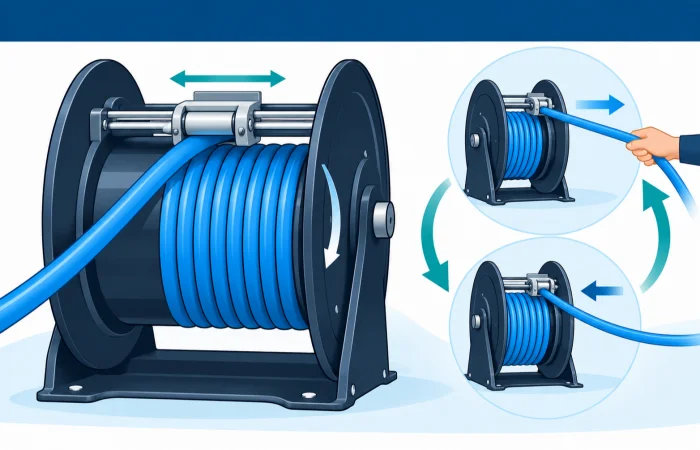
In addition to the reel structure, the retraction system also influences how well the hose is stored. Even with a well-designed reel, an inefficient retraction process can leave the hose unevenly wound or make it difficult to put away.
Retraction resistance is one factor to consider. If resistance is too high, operators must exert additional force to pull the hose back into the reel. If the hose retracts too quickly and its movement cannot be controlled, it may snap back suddenly or whip around, potentially striking nearby equipment. Both situations reduce ease of use and may increase the risk of damage to the hose and surrounding components.
In commercial cleaning environments where hose reels are used frequently, the retraction system should balance convenience with control. A semi-automatic retraction system can reduce the amount of manual effort required to organize and store the hose after use. However, its actual performance still depends on the design and how the system behaves during operation. The presence of a retraction mechanism alone does not guarantee smooth performance.
A retraction system also cannot replace proper operating practices. Operators should avoid releasing the hose suddenly or forcing it back into the reel when resistance is obvious. If the hose becomes stuck, they should first check the pulling direction, hose arrangement, and surrounding obstacles before attempting to retract it again.
In short, the reel structure determines how the hose moves and is arranged, while the retraction system affects how smoothly it returns to the reel. These two elements need to work together to reduce the need for repeated manual adjustments.
Although reel design is an important factor in hose tangling, the hose's own performance should not be overlooked. A hose must maintain its usability through repeated bending, pulling, and retraction. If it lacks flexibility or becomes stiff or deformed over time, pulling it out and storing it can become more difficult.
When purchasing a hose reel, buyers should confirm the hose length, diameter, operating temperature, working pressure, and abrasion resistance according to the actual cleaning requirements. Restaurant kitchens and food processing facilities may use hot water for cleaning, and the hose must also withstand frequent bending and pulling. Even with a well-designed reel, a hose that is unsuitable for the operating conditions may not maintain good performance over time.
The hose specifications must also be compatible with the reel structure. Excessive hose length may make storage more difficult, while an unsuitable diameter or bending profile may affect how the hose sits on the reel. Buyers should therefore evaluate the hose not simply by how soft it feels, but by how well its characteristics match the reel and the intended application.
Installation position determines the route the hose must follow during use. If the reel is too far from the main cleaning area, operators may need to pull out more hose or route it around worktables, pipes, and other equipment. Multiple bends can create additional friction and increase resistance during retraction.
Before installation, identify the main cleaning areas and typical operating routes. Position the reel so the hose can be pulled out along a natural path without repeatedly bending around obstacles or rubbing against nearby equipment. Sufficient clearance should also be provided around the reel to prevent the hose from repeatedly contacting sharp edges, trolleys, or other equipment during extension and retraction.
Hose performance, reel design, and installation position are closely connected. When all three are properly matched, the hose becomes easier to extend, retract, and maintain during everyday use.
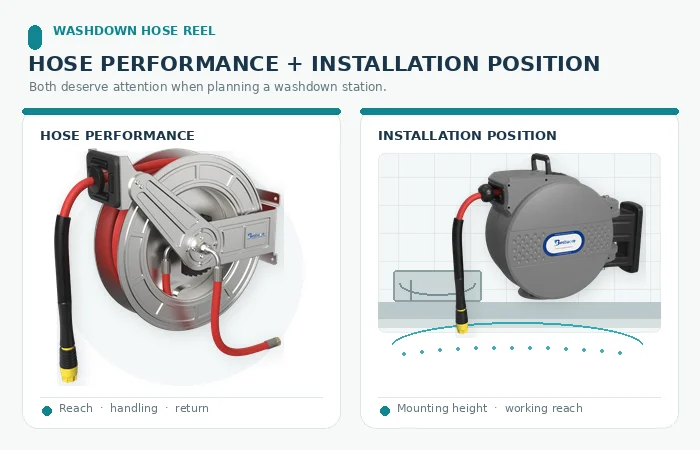
For buyers, product images and specifications provide only part of the picture. To determine whether a commercial hose reel is suitable for long-term use, it is also necessary to observe how the hose performs during actual operation. The following points deserve particular attention.
Pull the hose from the directions most commonly used in the cleaning area. Check for noticeable sticking, sudden increases in resistance, or situations where the hose must be repositioned repeatedly. Try pulling it from different angles to see whether the reel edges or surrounding structure interfere with its movement.
After retracting the hose, check whether it has accumulated in one area, overlapped excessively, or shifted toward one side. If the hose needs to be manually rearranged after every use, the storage process may need improvement.
If the product features a semi-automatic retraction system, observe whether the hose retracts smoothly and whether it snaps back suddenly, encounters excessive resistance, or requires additional effort. Retraction should reduce manual work while allowing operators to maintain reasonable control over the hose's movement.
Confirm that the hose length, diameter, and bending characteristics suit the reel design. Also verify that the hose's operating temperature and pressure ratings meet the requirements of the intended application. The hose and reel should be evaluated as a complete system rather than as separate components.
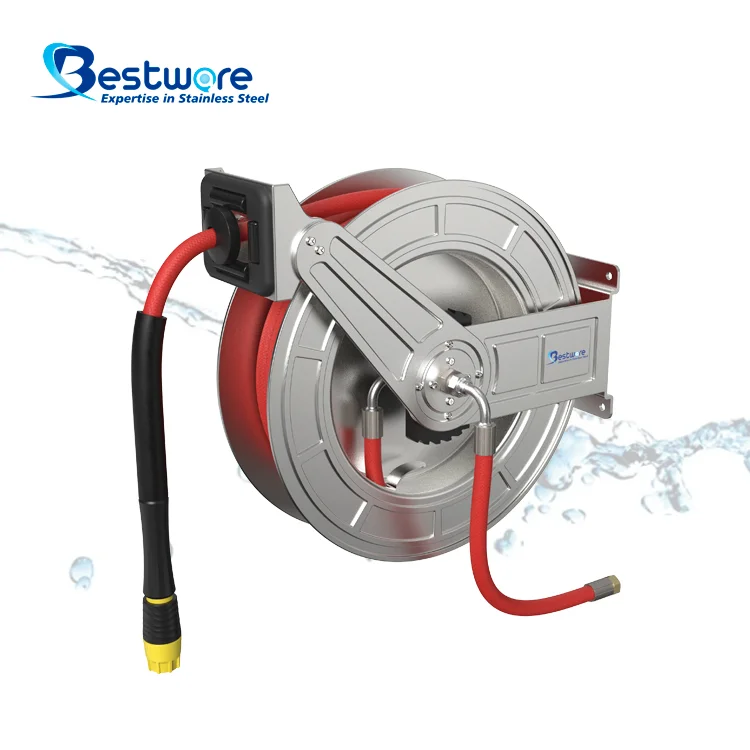
Check whether the reel position suits the cleaning route, whether the hose can be extended without repeatedly navigating around obstacles, and whether routine inspection and maintenance are convenient. When choosing between open and enclosed reels, consider the installation environment and maintenance requirements.
For larger purchasing projects, sample testing before placing an order is advisable whenever possible. Simulate actual working conditions by repeatedly extending and retracting the hose, including from the directions most commonly used on site. Compared with relying solely on product images or static specifications, practical testing is more likely to reveal problems that may arise during everyday use.

In commercial kitchens, hotels, and other high-frequency cleaning environments, a hose reel needs to do more than deliver water for rinsing. It should also support convenient hose management and ease of operation.
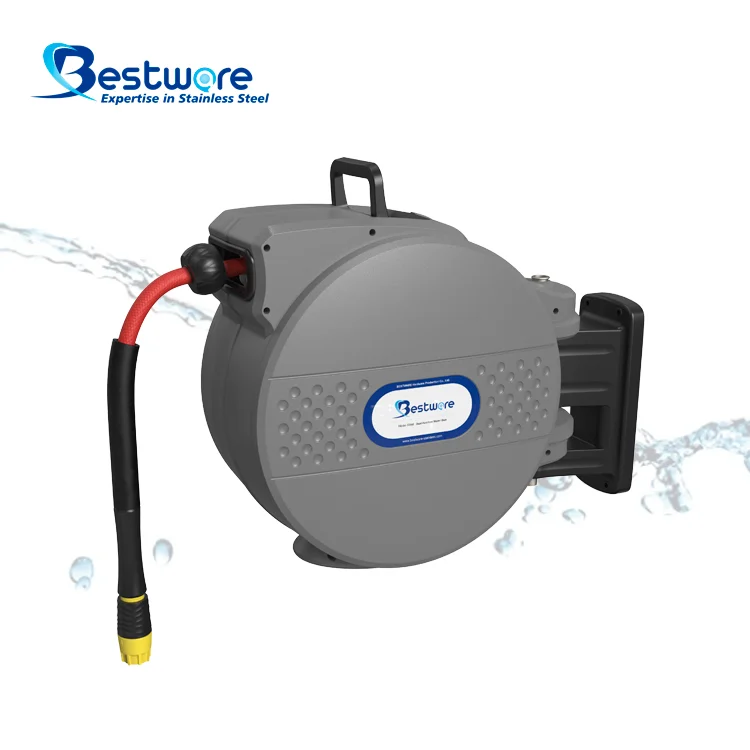
Bestware offers hose reels in both open and enclosed designs to accommodate different installation environments and maintenance requirements. Open reels make inspection easier, while enclosed reels help reduce direct exposure of the hose to the surrounding environment. Buyers can select the appropriate configuration based on available space, cleaning routes, and routine maintenance needs.
For hose storage, Bestware products feature a semi-automatic retraction system that reduces the manual effort required to organize the hose after use. For cleaning tasks that involve frequent extension and retraction, this design makes hose storage more convenient. Actual performance should still be assessed in relation to the installation method, operating practices, and site conditions.
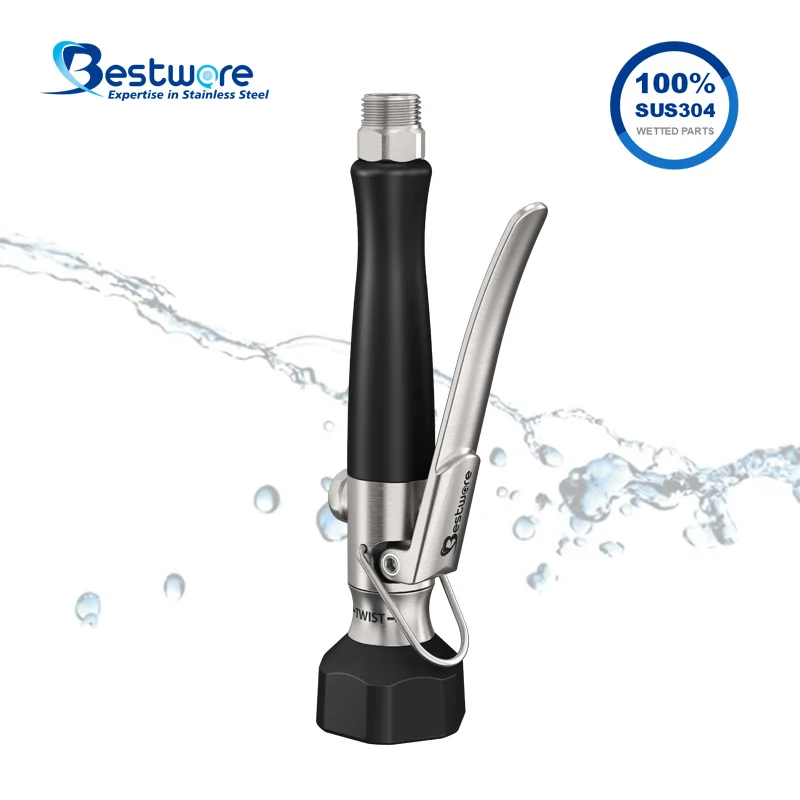
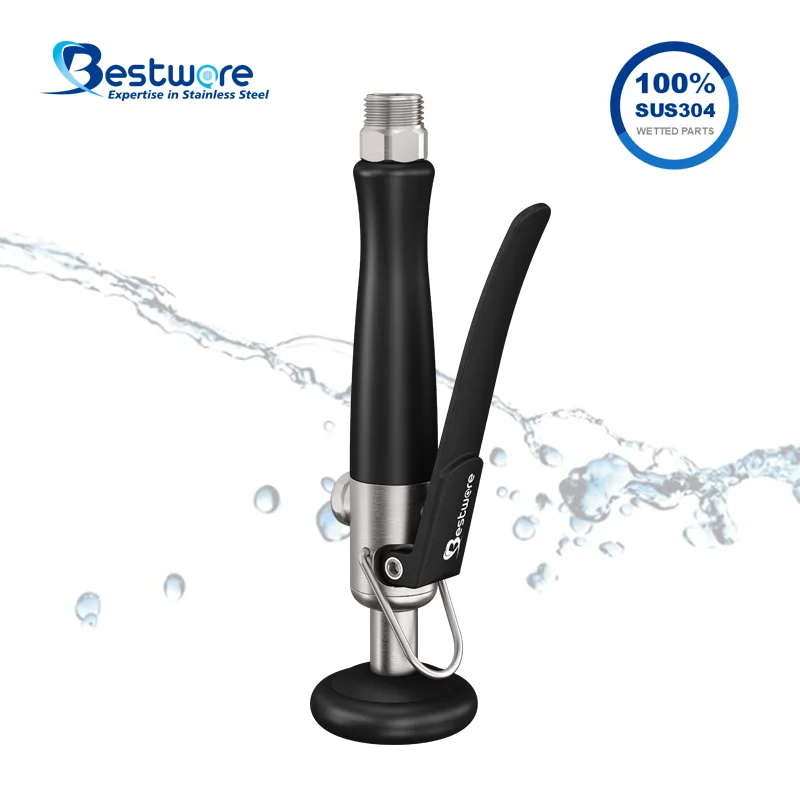
In addition, Bestware's self-developed dual-function water gun switches between Powerful Washing and Large-Area Washing modes. These modes are suited to different cleaning tasks: concentrated rinsing of stubborn dirt and broader coverage of larger surfaces. Operators can select the appropriate spray mode for the cleaning task, making rinsing more flexible.
When selecting a commercial hose reel, it is more useful to consider reel design, retraction performance, hose specifications, and water gun functionality together than to compare any single feature in isolation. A product that matches the requirements of the installation environment can better support cleaning efficiency, ease of operation, and routine maintenance.
A hose that frequently tangles on a commercial hose reel does not necessarily have a problem with the hose itself. Reel design, retraction performance, hose compatibility, and installation position can all affect how the hose performs during everyday use. For high-frequency cleaning environments such as restaurant kitchens, hotel kitchens, and food processing facilities, buyers should look beyond hose length, water gun functionality, and product appearance. The entire process of extending, using, and retracting the hose deserves attention. Practical testing can help buyers assess whether the hose pulls out smoothly, winds back neatly, and follows the cleaning routes required on site. A well-designed commercial hose reel should not only deliver water effectively to the areas that need cleaning but also allow the hose to be retracted conveniently after every use. When the reel design, hose characteristics, and installation layout work together, unnecessary hose handling can be reduced and daily cleaning tasks can proceed more smoothly
One-stop Solution Provider of Stainless Steel Commercial Faucets
Email: business@bestware-stainless.com
after-sales@bestware-stainless.com
Tel: +86 18929047065
WhatsApp: +86 18929047065


WeChat: +86 18929047065


Website: www.bestware-stainless.com(Global Site)
www.bestware-sparkling.com(Water Dispenser)
Add: Block 8, No. 6, Jianda Nan Road, Jiangmen, Guangdong, China
Copyright © Bestware Hardware Production Co., Ltd. All Rights Reserved.