Date: 2026-09-19
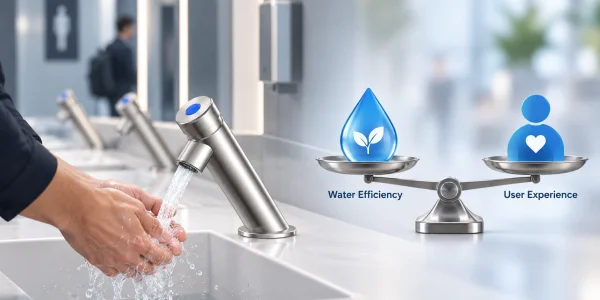
In public restrooms, sensor faucets can automatically turn on the water when a user approaches and stop the flow when the user moves away, making them widely used in hotels, airports, hospitals, office buildings, and commercial complexes. However, in actual use, sensor faucets can sometimes behave in unexpected ways: the faucet suddenly turns on when no one is washing their hands; the water is accidentally activated when cleaning staff wipe the washbasin; or another faucet responds when someone is using the faucet next to it. These situations are generally referred to as false activation. They do not necessarily mean that the sensor faucet is malfunctioning. For sensor-operated products, the sensor determines whether to activate based on changes in the detected area, while public restrooms happen to be environments with frequent people movement, concentrated equipment, and constantly changing conditions. Therefore, understanding why commercial sensor faucets may experience false activation requires looking beyond the sensor itself and considering the actual installation environment and usage conditions.
Before determining whether a sensor faucet is prone to false activation, it is first necessary to understand which situations in actual use may cause the faucet to turn on when no one is performing a normal hand-washing action.
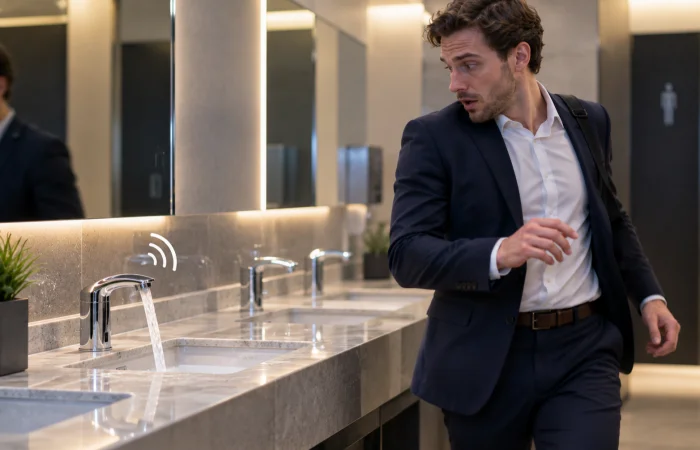
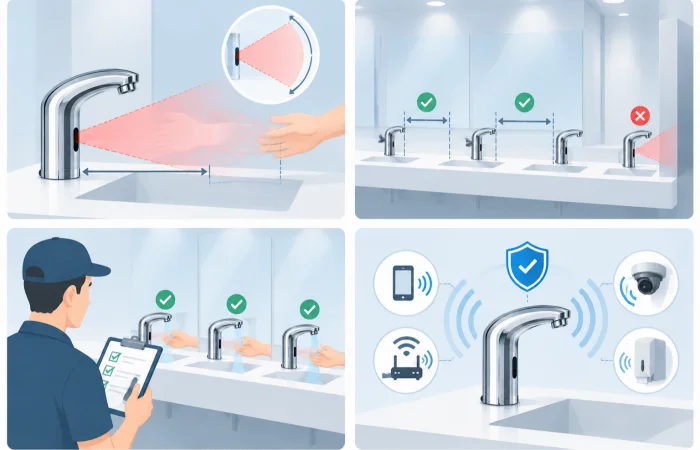
Washbasins in public restrooms are sometimes located near entrances or main traffic areas. When users enter or leave the restroom, or simply walk past the washbasin, their bodies may enter the sensing area.
For a traditional mechanical faucet, someone walking past would have no effect because the faucet only turns on when someone operates the handle. A sensor faucet works differently. Its sensor detects changes in targets within the area in front of it. If the sensing area extends into a walkway and a person enters the detection range while passing by, the system may interpret this movement as an activation signal.
Therefore, when the washbasin is located close to a walkway, false activation caused by passing users should be given particular attention during installation and commissioning.
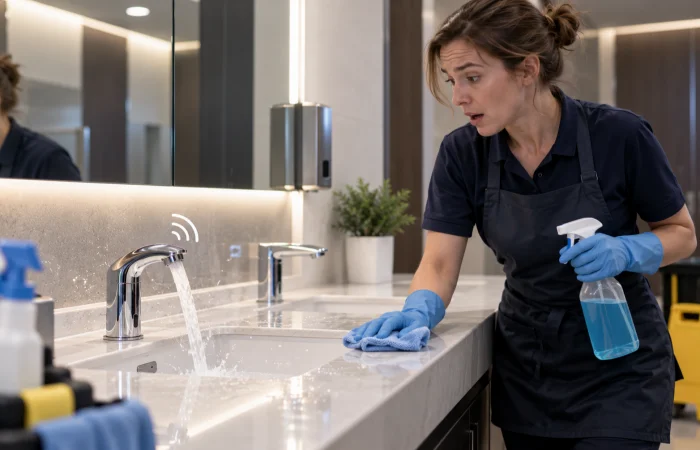
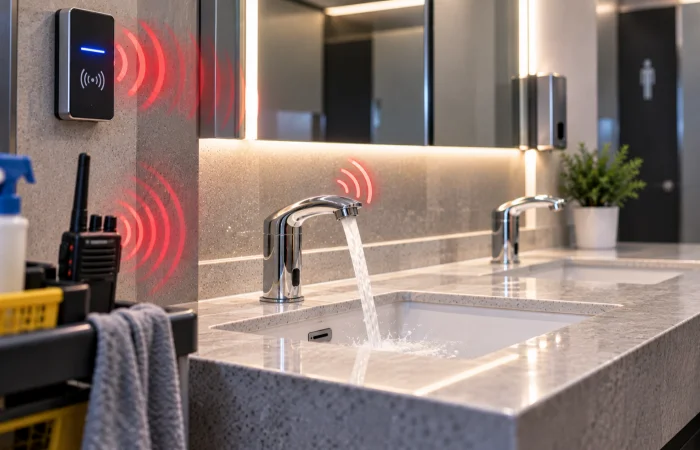
Cleaning staff are a particular type of user in public restrooms. Ordinary users generally only place their hands near the water outlet, while cleaning staff need to wipe the countertop, clean the faucet, and remove dirt around the washbasin. Cloths, arms, and cleaning tools may move frequently around the faucet. If these movements enter the sensor's detection range, the faucet may be activated unintentionally.
This situation is particularly worth considering because cleaning takes place repeatedly every day. If the faucet is frequently activated during cleaning, it may not only result in unnecessary water consumption but also disrupt the cleaning process. Therefore, when evaluating a sensor faucet, it is important not to look only at its performance during normal hand washing, but also to consider what may happen during actual cleaning operations.
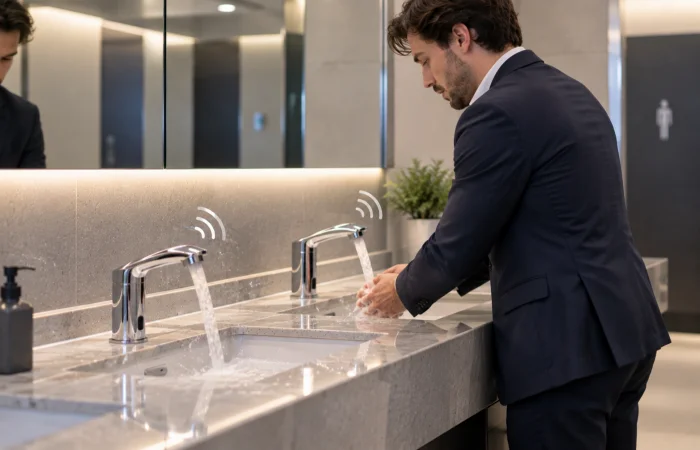
Commercial restrooms commonly use multiple washbasins installed in a continuous row. Several or even more than a dozen sensor faucets may be installed on the same washbasin countertop.
This installation arrangement places higher demands on the sensors. For example, when a user washes their hands at the second washbasin, their arm or body movement may also enter the detection area of the adjacent faucet. If the effective sensing areas of adjacent sensors are too close to each other, unnecessary activation may occur.
This situation does not necessarily indicate a problem with an individual faucet. It may instead be related to the overall sensing areas created after multiple products are installed together. Therefore, when installing sensor faucets in batches, it is not enough to test whether a single faucet operates normally. The actual performance of multiple faucets installed continuously should also be evaluated.
The target causing false activation does not necessarily have to be a person. In some compact public restrooms, there may be walls, mirrors, countertop structures, partitions, or other fixed facilities around the faucet. If these structures are located too close to the sensor, they may enter the sensor's detection range.
This is particularly relevant in renovation projects, where the available space has often already been determined and the faucet cannot always be installed in an ideal position. In such cases, even if the same faucet performs normally in a spacious environment, its sensing performance may be different when installed on a smaller washbasin.
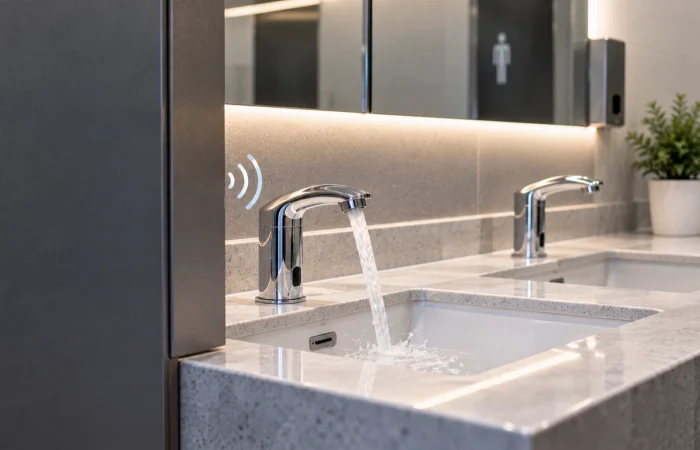
Public restrooms also typically contain a large number of electronic devices. Lighting systems, automatic doors, elevators, motors, and other electronic systems may operate simultaneously. A sensor faucet itself also contains sensors, solenoid valves, and control circuits, making its operating environment more complex than that of a traditional mechanical faucet.
If the electronic control system does not have sufficient interference resistance, a complex site environment may increase the possibility of abnormal responses. This type of problem is often less noticeable than activation caused by passing users because it may occur only occasionally. Everything may appear normal during the initial installation test, while abnormal responses may occur later during long-term operation under certain site conditions.
After identifying the situations that may cause false activation, another basic question needs to be addressed: why does the sensor interpret these movements as activation signals?
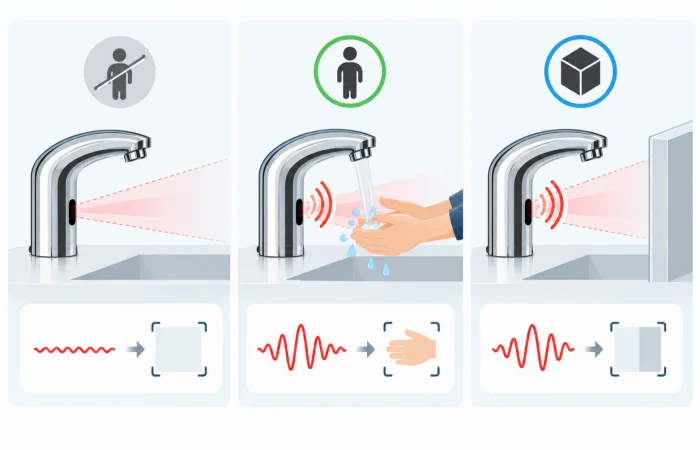
This is one of the most important points in understanding false activation. People understand why they are standing in front of a washbasin. For example, someone walking past a washbasin may simply be heading to another area and have no intention of washing their hands; a cleaning staff member reaching toward the faucet is trying to wipe the countertop, not use the water. However, a sensor cannot understand these intentions. It detects targets within its sensing area and changes in those targets. Therefore, when a movement is sufficiently similar to a normal activation movement from the sensor's perspective, there is a possibility that it will be identified as an activation signal. This is why sensor faucet design cannot focus only on normal hand-washing movements, but also needs to take various non-use movements in public restrooms into account.
Many people directly compare sensing distances when choosing sensor faucets. However, sensing distance only describes the approximate range in which the sensor can detect a target and does not fully represent actual sensing performance. What really affects false activation is the relationship between the overall sensing area and the installation environment. If the sensing area is too large, the walkway, wall, or other fixed structures near the washbasin may enter the detection range; if it is too small, users may need to repeatedly adjust the position of their hands to activate the water. Therefore, what matters when choosing a sensor faucet is a suitable sensing area rather than simply pursuing a longer sensing distance.
The environment faced by the same sensor faucet can be completely different from one project to another. For example, a faucet installed on an individual washbasin usually has relatively open space in front of it, while a faucet installed on a continuous washbasin may have another faucet immediately beside it, with a wall or mirror behind it. Wall-mounted installation also changes the relative position between the sensor and the user. Therefore, the sensing performance of the product itself is only a basic condition. The actual sensing performance ultimately depends on the environment the sensor faces after installation.
If a sensor faucet operates in a relatively quiet and isolated environment, the number of targets within its detection range is limited. Public restrooms, however, are completely different.
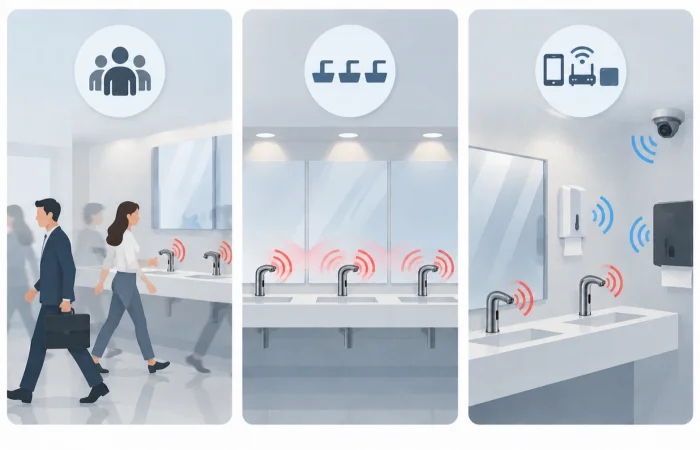
Public restrooms may have a large number of different users coming and going every day. Some people wash their hands, some walk past, some adjust their clothes in front of the mirror, and others wait beside the washbasin. These movements increase the number of moving targets detected by the sensor. The effect becomes more noticeable when the washbasin is located near a main traffic area.
Sensor faucets in public restrooms are usually not installed individually. Multiple products are often installed together. As the number of devices increases, the installation position of each sensor, the distance between adjacent faucets, and their sensing areas all become factors that need to be considered.
This is also an important difference between commercial projects and residential use. A residential restroom may only require one faucet, while a large commercial project may require dozens or even more products to perform consistently.
Commercial buildings generally contain more electronic devices than residential environments. This means that sensor faucets not only have to operate amid complex human activity, but also in a relatively complex electronic environment. Therefore, the stability of the sensors, solenoid valves, and control systems can all affect the final performance.
For contractors, designers, and purchasing professionals, the key issue with false activation is not an isolated parameter, but whether the product matches the project environment.
When purchasing a sensor faucet, the sensing distance can be considered, but it should not be used as the sole basis for determining whether the product is suitable for a project. More importantly, it is necessary to understand the actual detection area of the sensor and whether the product is likely to be affected by surrounding structures and people movement after installation.
If the washbasin is close to a walkway, particular attention should be paid to whether people passing by can easily enter the sensing area. If the washbasins are installed in a continuous row, the distance between adjacent faucets and their sensing areas should be considered. In smaller restrooms, it is also necessary to confirm in advance whether walls, mirrors, and countertop structures may enter the sensor's detection area.
Commercial projects often require batch installation, so sample testing before formal installation is particularly important. Testing should not be limited to normal hand-washing movements. Situations such as people walking past, cleaning the countertop, and using adjacent faucets can also be simulated. These practical tests can help identify any mismatch between the sensing area and the installation environment at an early stage.
For large hotels, hospitals, airports, and commercial complexes, there are usually many electronic devices operating on site. Therefore, the interference resistance of the product should also be considered during purchasing. This capability cannot always be judged from the appearance of the product, but it can affect the long-term operating stability of the faucet in a complex commercial environment.
When developing commercial sensor faucets, Bestware focuses more on how the products can adapt to real commercial environments rather than simply pursuing a single sensing parameter.
In the sensing system, the products use high-sensitivity sensing technology and incorporate interference-resistant design to improve sensing stability. Some models offer a response time of up to 0.2 seconds and are equipped with 10 V/m interference-resistant solenoid valves, helping them better handle complex electronic environments in commercial settings.
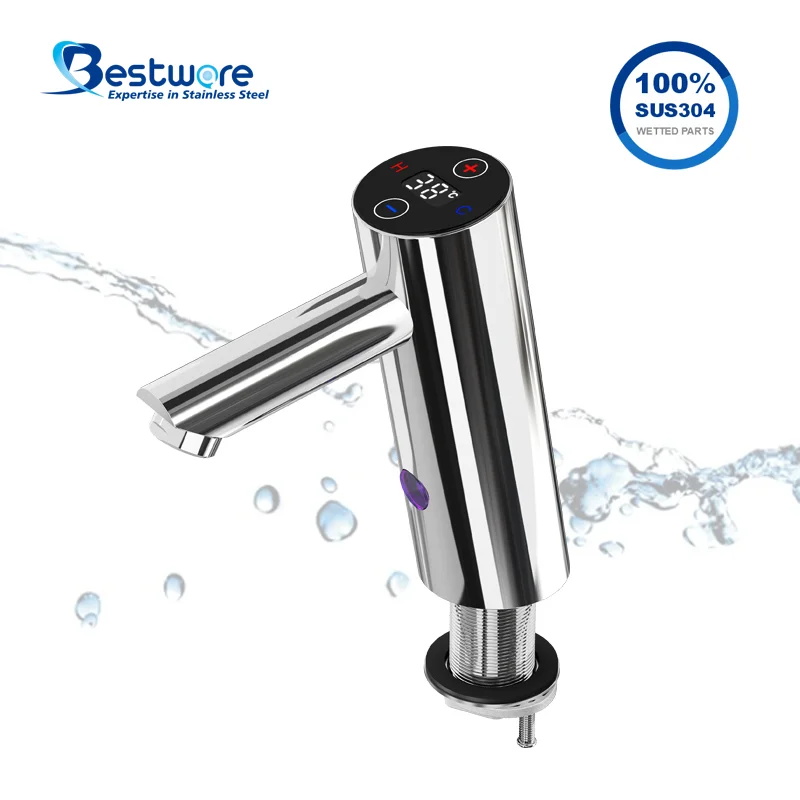
For models with hot and cold water, Bestware also integrates sensor control with an intelligent thermostatic system, allowing users to adjust the water temperature more intuitively while reducing the impact of water pressure changes on the outlet temperature.
These designs focus on a practical objective: enabling sensor faucets to more reliably recognize normal user actions in commercial restrooms while minimizing unnecessary activation caused by environmental factors.
False activation in commercial sensor faucets is not necessarily caused by a sensor malfunction. People walking past the washbasin, cleaning staff wiping the countertop, adjacent faucets being used, surrounding structures entering the detection area, and complex electronic environments can all affect sensing performance. The common factor is that sensor faucets respond to changes within the detection area rather than understanding whether a person actually intends to use the faucet. For commercial projects, instead of simply pursuing a longer sensing distance or faster response speed, sensor faucets should be evaluated based on the actual installation and usage environment. The key is whether the product can reliably distinguish normal user actions from non-use movements and reduce unnecessary activation.
One-stop Solution Provider of Stainless Steel Commercial Faucets
Email: business@bestware-stainless.com
after-sales@bestware-stainless.com
Tel: +86 18929047065
WhatsApp: +86 18929047065


WeChat: +86 18929047065


Website: www.bestware-stainless.com(Global Site)
www.bestware-sparkling.com(Water Dispenser)
Add: Block 8, No. 6, Jianda Nan Road, Jiangmen, Guangdong, China
Copyright © Bestware Hardware Production Co., Ltd. All Rights Reserved.
(2).webp)
(1).webp)