Date: 2026-09-11
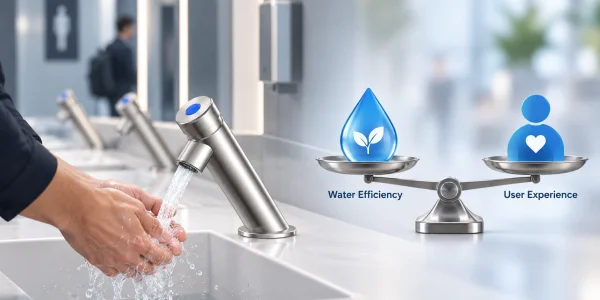
In high-frequency-use environments such as public restrooms, schools, hospitals, and commercial facilities, metering faucets automatically shut off the water after a preset flow duration, helping reduce water waste caused by users forgetting to turn off the faucet or using more water than necessary. However, water efficiency is not simply about shortening the flow duration. It also requires consideration of flow rate, operating force, water flow stability, and the actual needs of different users. If the metering time is too short, users may need to press the faucet repeatedly; if it is too long, it may result in unnecessary water consumption. Therefore, the key to a metering faucet is not to shut off the water as quickly as possible, but to match the flow duration to actual usage needs and achieve a balance between water efficiency and user experience.
A metering faucet automatically shuts off the water after a preset flow duration once the user activates the water. The principle behind its water-saving function may seem straightforward, but water consumption per use is not determined by metering time alone.
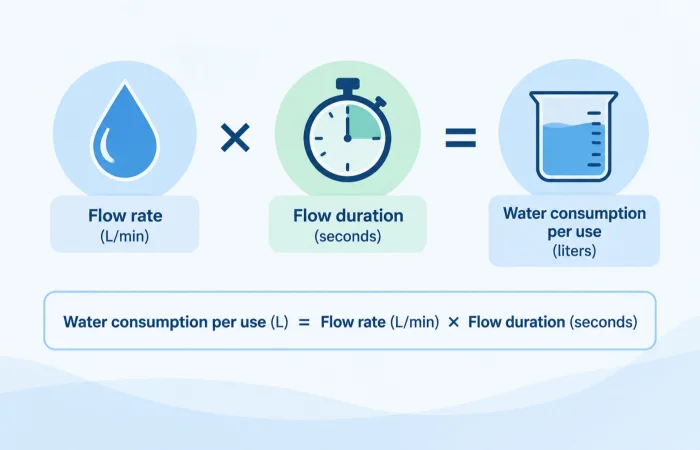
The basic relationship can be expressed as: Water consumption per use = Flow rate × Flow duration
For example, if a faucet delivers water at a flow rate of 4 liters per minute for 10 seconds, the theoretical water consumption is approximately 0.67 liters. If the flow rate increases to 6 liters per minute, water consumption per use will reach approximately 1 liter even with the same 10-second flow duration.
Therefore, simply reducing the flow duration from 10 seconds to 8 seconds does not necessarily mean that a product is more water-efficient than a 10-second model. What really needs to be considered is the flow rate per unit of time, the duration of each activation, and whether users can complete their actual water-use tasks within that cycle.
The U.S. Environmental Protection Agency also points out in its commercial water management guidance that the cycle length of metering faucets is directly related to the allowable flow rate. For metering faucets in public restrooms, a common requirement is to limit water consumption to 0.25 gallons, or approximately 0.95 liters, per cycle. This means that water-efficient metering faucet design is essentially a combination of multiple factors rather than a matter of pursuing a single number.
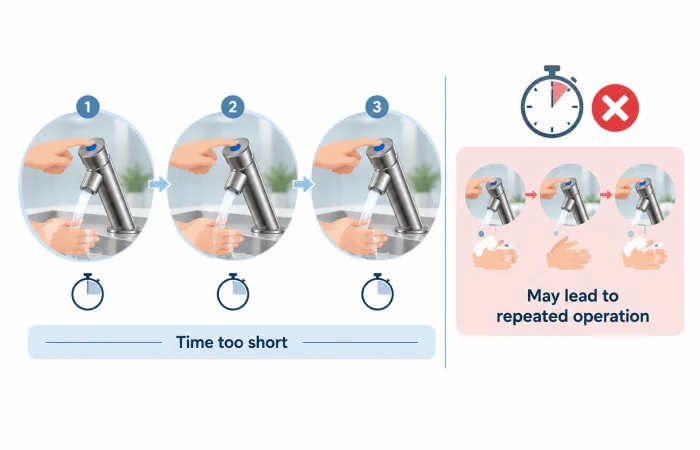
Suppose the flow duration of a faucet is very short, and the water shuts off before the user has finished washing their hands. In this case, the user has to press the faucet again. From the perspective of product specifications, the flow duration of each activation has indeed been reduced; however, in actual use, the user may need to activate the faucet twice or even more to complete a single handwashing process. In this case, although the product reduces the duration of each individual flow cycle, it does not actually address the user's water needs during the process.
This is also an easily overlooked point when evaluating metering faucets: what really needs to be reduced is unnecessary water consumption, not the water actually needed for use. A metering faucet should automatically stop the water when it is no longer needed, rather than shutting it off while the user still needs water. Therefore, an appropriate metering time should be based on actual user behavior. For different applications, the optimal time may not be the same.
Although public restrooms, schools, hospitals, and commercial facilities are all high-frequency-use environments, their users and usage patterns can vary significantly. In locations with high user turnover, users may need to complete a quick rinse; schools need to take children's operating habits into account; hospitals and certain specialized facilities may place greater emphasis on thorough handwashing. If all these environments use exactly the same metering time, it is difficult to meet all of these needs simultaneously.
Therefore, the real value of metering design is not simply providing an automatic shutoff function, but allowing the flow cycle to match the actual application. For example, a 6-second flow duration may be suitable for some applications that require quick access to water, while a longer metering time can provide more time for tasks that require more thorough cleaning. For products with a relatively wide adjustment range, an adjustable range of 6 to 16 seconds allows users to select an appropriate flow duration according to their actual needs rather than being forced to use a fixed cycle.
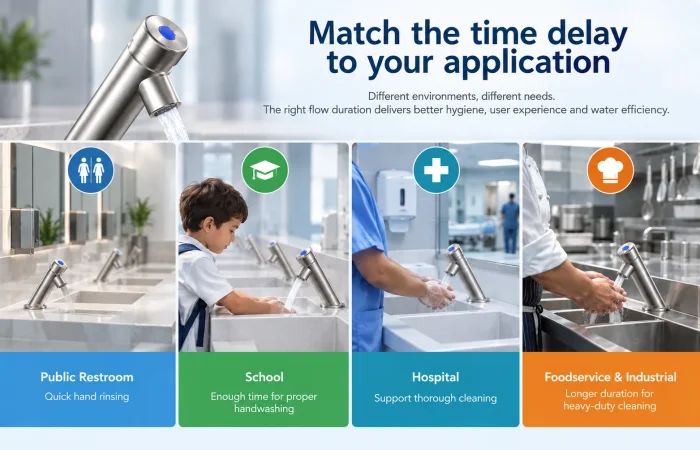
If the metering time is too long, water may continue to flow after the user has left, resulting in unnecessary water consumption. If the metering time is too short, the user may need to reactivate the water repeatedly. Therefore, an appropriate design should find a balance between the two. It should allow one normal activation to cover the user's actual water needs as much as possible while preventing the water from continuing to flow after the user has stopped using it. This is also an important difference between metering faucets and conventional manual faucets in public applications. Conventional faucets rely more heavily on users to shut off the water themselves, while metering faucets establish a more defined limit on water use through a preset cycle. However, whether this limit is appropriate ultimately depends on whether it reflects real-world usage conditions.
A metering faucet requires the user to press the actuator to start the water flow, making the operating force an important part of the product experience. U.S. accessibility standards specify that operable parts should be operable with one hand, without requiring tight grasping, pinching, or twisting of the wrist, and set a maximum operating force of 5 pounds, or approximately 22.2 newtons.
If activating the water requires significant force, children, older adults, or users with limited hand strength may find the faucet difficult to use. For public facilities that undergo a large number of repeated operations every day, even a small difference in the force required for each operation can become a noticeable burden over time. Therefore, reducing the activation force is not simply an additional feature unrelated to water efficiency.
An easier operation lowers the effort required to start the water, making it easier for users to operate the faucet as intended without repeatedly pressing the actuator, using body weight, or changing their operating method to activate the water. With a design that reduces the activation force by approximately 50%, the improvement is not limited to the feel of a single press, but also enhances the metering faucet's ability to accommodate different users.
In addition to the activation method, the water flow itself is equally important. Water pressure in commercial buildings does not necessarily remain stable at all times. Supply conditions may change depending on the time of day, building level, and periods of peak water demand. If a faucet is highly sensitive to changes in water pressure, the flow may become inconsistent or cause splashing. This can affect the user experience and may also indirectly affect water efficiency.
For example, if the water flow is too weak, users may feel that one cycle does not provide enough water and need to reactivate the faucet; if the flow suddenly becomes stronger, it may cause splashing, meaning that some of the water is not actually used for handwashing. Therefore, the stability of a metering faucet requires it to provide a stable, gentle water flow under different water pressure conditions. This is why pressure-balancing design is particularly important for metering faucets. Its purpose is not to make the water flow more complicated, but to allow the product to maintain relatively stable performance even when actual building water supply conditions change.
Faucets installed in public restrooms and commercial facilities face different operating conditions from those in residential environments. They must not only withstand more frequent activation and shutoff cycles, but also prolonged exposure to humid environments, changes in water quality, and routine cleaning and maintenance. Therefore, the choice of material for the faucet body should not be based solely on appearance; long-term corrosion resistance and structural stability also need to be considered.
Food-grade 304 stainless steel offers good corrosion resistance and structural stability, while the material itself is recyclable, making it suitable for high-frequency-use environments such as public restrooms, schools, hospitals, and commercial facilities. For applications with higher material performance requirements, 316L stainless steel can also be used.
The material itself does not directly determine whether a faucet is water-efficient, but it can affect whether the product is able to maintain its original control performance over long-term use. Therefore, durability is also a factor that needs to be considered in water-efficient design.
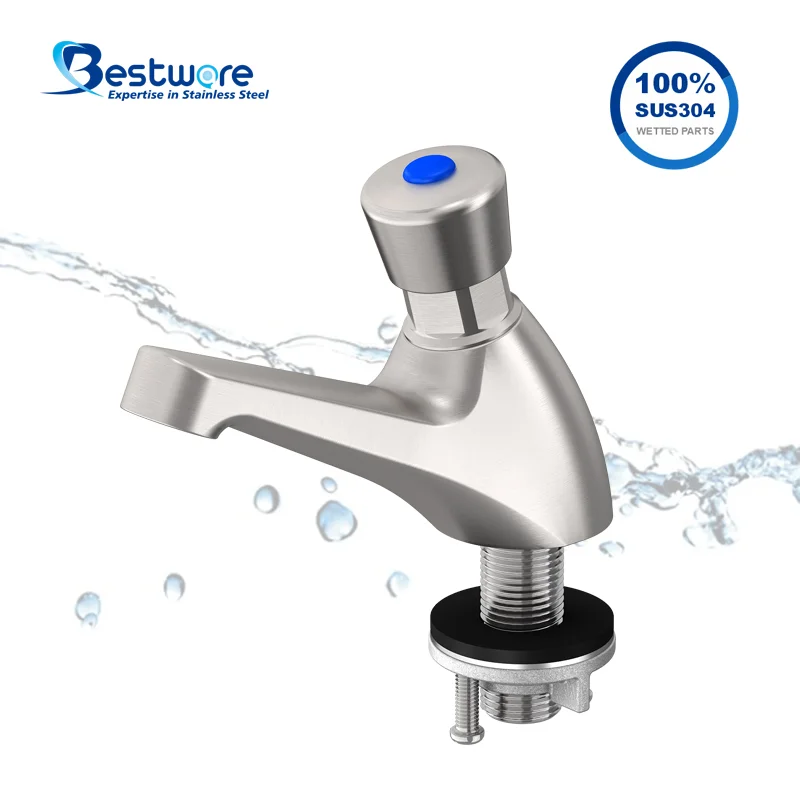
Bestware focuses on commercial faucets for high-frequency-use environments such as public restrooms, schools, hospitals, and commercial facilities, providing metering faucet solutions for different public spaces. For metering faucets, water efficiency is not simply about shortening the flow duration. Bestware considers the actual usage process by combining metering time, flow rate, operating force, and water flow stability in the design, enabling the product to meet basic water-use needs while reducing unnecessary continuous water flow.
In terms of operation, the easy-press design reduces the force required to activate the water, making the product more suitable for users of different ages and physical abilities; the pressure-balancing design helps accommodate changes in water pressure, maintain a stable and gentle water flow, and reduce splashing and repeated activation caused by unstable flow. Considering the long-term, high-frequency use of public facilities, Bestware also focuses on valve control, internal filtration, and faucet body materials, helping the product maintain stable activation, continuous water flow, and reliable shutoff over long-term use.
For purchasers, evaluating a metering faucet should not be limited to comparing “how many seconds until shutoff.” It is also necessary to consider whether one activation is sufficient for normal use, whether the faucet is easy to operate, whether the water flow remains stable, and whether the product can maintain reliable performance under long-term, high-frequency use. Only when all these factors are considered together can water efficiency move beyond a single product specification and become long-term value for public spaces.
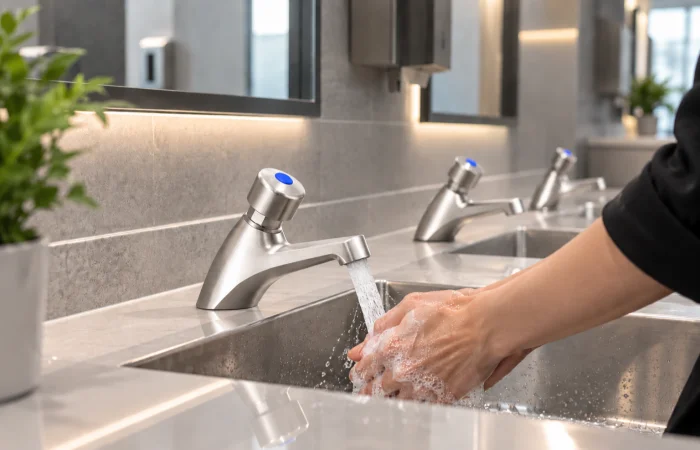
Water efficiency in metering faucets is not simply about shortening the flow duration. It requires a balance between flow duration, flow rate, operating force, and water flow stability. A well-designed faucet should allow water to flow when it is needed and stop promptly when it is no longer needed, while ensuring that users can operate it easily and that the faucet remains stable and reliable over long-term use. For public restrooms, schools, hospitals, and commercial facilities, truly effective water efficiency means reducing unnecessary water consumption rather than sacrificing the time and experience required for normal use.
One-stop Solution Provider of Stainless Steel Commercial Faucets
Email: business@bestware-stainless.com
after-sales@bestware-stainless.com
Tel: +86 18929047065
WhatsApp: +86 18929047065


WeChat: +86 18929047065


Website: www.bestware-stainless.com(Global Site)
www.bestware-sparkling.com(Water Dispenser)
Add: Block 8, No. 6, Jianda Nan Road, Jiangmen, Guangdong, China
Copyright © Bestware Hardware Production Co., Ltd. All Rights Reserved.
(2).webp)
(1).webp)