
Date: 2026-09-07
In a commercial kitchen, it is often difficult to determine whether a spray valve is truly good based on its first use alone. At the beginning, factors such as water flow strength, ease of operation, and water flow stability are indeed important indicators of spray valve performance. However, for restaurants, hotels, central kitchens, cafeterias, and food processing facilities, the equipment is not used occasionally. Instead, it faces dozens or even hundreds of repeated operations every day. Therefore, evaluating a commercial spray valve should not be based solely on a single-use experience. It is more important to observe how it performs throughout an entire workday. How many times does a spray valve need to be used each day? How many actions are required for each operation? Does it remain stable after extended use? These questions often reveal its true value in use more effectively than simply comparing its appearance or purchase price.
Many tasks in commercial kitchens are highly repetitive. Employees repeatedly pick up the spray valve, turn the water flow on and off, adjust the rinsing direction, and change the way they operate it according to different cleaning tasks. Some subtle differences in a single operation may not be immediately noticeable.
For example, an operation that requires slightly more effort may not have a noticeable impact the first time it is used. However, after prolonged and continuous operation, the burden of operating the equipment gradually becomes apparent. Similarly, insufficient water coverage during a single rinse may only require the employee to move the spray valve slightly. But when this happens repeatedly, it can lead to unnecessary adjustments and repeated rinsing. Therefore, the performance of a commercial spray valve cannot be evaluated independently of its frequency of use. The more frequently the equipment is used, the more its individual details are magnified.

Compared with cleaning equipment used less frequently, commercial kitchens require much more frequent operation, movement, and rinsing. Therefore, when making a purchase, greater attention should be paid to the equipment's stability under long-term, high-frequency use, including whether it operates smoothly, whether the water flow remains stable, and whether the sealing and connection components are durable.
Therefore, what commercial equipment truly needs to demonstrate is long-term performance:
· Do the switches and control components remain smooth after frequent operation?
· Can employees still operate it with ease after long periods of work?
· Does the water flow remain stable during continuous rinsing?
· Does it require frequent tool changes when handling different cleaning tasks?
· Do the sealing and connection components remain reliable after long-term use?
These factors often reveal the actual value of a commercial spray valve more effectively than its appearance and feel when it is first used.
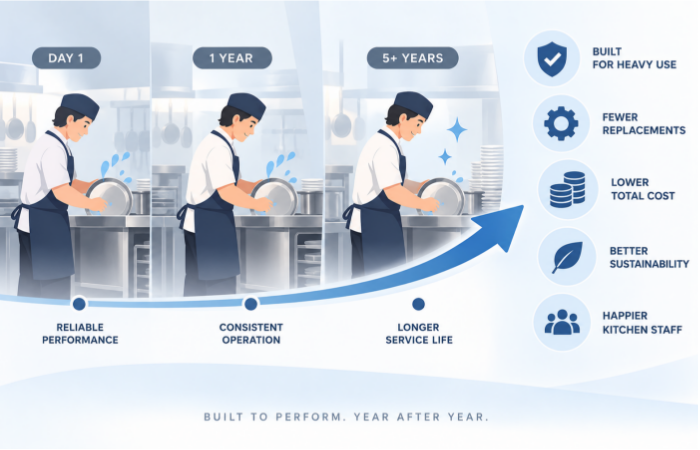
A spray valve is a typical handheld device. During use, employees need to hold the spray valve continuously while performing actions such as pressing, rotating, moving, and controlling the direction of the water flow. If the equipment itself requires considerable operating force, the burden of operation will gradually become apparent after long periods of work. This is why ergonomic design is an important consideration for commercial equipment.
For restaurants, hotels, central kitchens, and other facilities that operate continuously every day, employees may need to handle a large number of cleaning tasks consecutively. How easy the equipment is to operate can directly affect the continuity of the entire cleaning process. Therefore, the operating experience of a spray valve should be evaluated in a continuous-use environment rather than by simply trying it for a few minutes and drawing a conclusion.

Cleaning efficiency is not determined by water flow strength alone. In actual use, employees may face cleaning objects of different sizes and different types of stains, each requiring a different level of water coverage. If the water flow is concentrated in a small area, employees need to constantly move the spray valve to cover the entire cleaning area. If the water flow is not distributed evenly enough, some areas may not be rinsed thoroughly and require additional treatment.
This means that a truly efficient spray valve needs to take into account impact force, coverage, and water flow distribution at the same time. For high-frequency use, a well-designed water flow can reduce repeated adjustments made to compensate for insufficient coverage, making every rinse more effective.

Cleaning tasks in commercial kitchens are usually not limited to a single type. Stubborn grease on cookware, residue on plates, and large areas of stains on work surfaces do not necessarily require the same type of water flow. If a spray valve can only accommodate one particular cleaning method, employees may need to change the spray nozzle or use other tools to complete different tasks.
Changing accessories means that employees need to pause the current operation, find the accessory, remove the existing one, install another, and then resume work. For equipment used frequently, these repeated actions can continually interrupt the workflow. In addition, detachable accessories are more likely to experience wear, loss, or mismatching in a busy kitchen environment. Therefore, from a long-term use perspective, reducing unnecessary equipment changes is itself a way to improve workflow continuity.
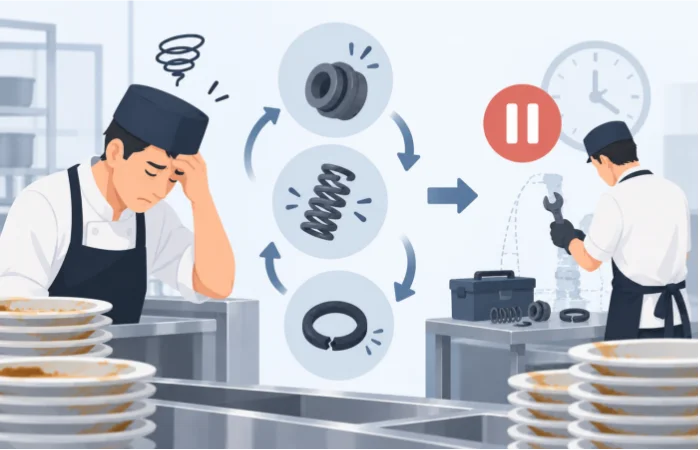
The requirements for spray valves in commercial kitchens are not essentially about making one particular performance stand out. Instead, they are about ensuring that the equipment remains stable during long-term, high-frequency use.
Bestware starts from the actual working scenarios of commercial kitchens and comprehensively optimizes its spray valves for cleaning efficiency, operating load, water flow design, and durability. Currently, Bestware spray valves have been used by multiple internationally recognized brands in actual operating environments, demonstrating their stability and consistent cleaning efficiency under high-frequency, high-intensity use.
For a spray valve that needs to be operated repeatedly every day, durability must withstand the test of repeated use. Bestware spray valves have undergone more than 200,000 cycle tests to verify their stability under long-term repeated operation. The significance of this figure is not simply to pursue a higher test count, but to demonstrate that the product is not designed only for short-term use and has instead taken into full consideration the practical demands of high-frequency operation in commercial kitchens.
Bestware spray valves feature 24 water outlets, with the angle and height of each outlet optimized through design. The focus here is not simply on increasing the number of water outlets, but on adjusting the water outlet direction and water flow distribution to achieve more even coverage of the target area. For high-frequency cleaning, more balanced water flow distribution can reduce the need for employees to constantly reposition the spray valve to compensate for insufficient coverage, thereby improving overall rinsing efficiency.
Bestware spray valves combine ergonomic design with hydraulic cushioning, reducing the overall operating force required by approximately 75% compared with similar products on the market. For a single operation, reducing the operating force may simply improve the user experience. However, for employees who use a spray valve repeatedly every day, reducing the load associated with long-term repetitive operation has much more practical significance.
Judging whether a commercial spray valve is good or not cannot be based solely on how it performs during its first use. For commercial kitchen equipment that needs to be operated repeatedly every day, the real factors worth paying attention to are the details that can easily be overlooked during long-term use: whether it is easy to operate, whether the water flow remains stable, whether the coverage is appropriate, whether cleaning is efficient, and whether the equipment can withstand continuous repeated use. These differences may not be obvious under low-frequency use, but as the number of operations increases, they gradually become reflected in employee operating load, cleaning workflow efficiency, and the long-term maintenance costs of the equipment. Therefore, when purchasing a commercial spray valve, rather than simply comparing price and single-use experience, it is more valuable to consider whether the product has been validated for high-frequency use and whether the supplier can provide actual data on cleaning efficiency, operating load, and durability.
One-stop Solution Provider of Stainless Steel Commercial Faucets
Email: business@bestware-stainless.com
after-sales@bestware-stainless.com
Tel: +86 18929047065
WhatsApp: +86 18929047065


WeChat: +86 18929047065


Website: www.bestware-stainless.com(Global Site)
www.bestware-sparkling.com(Water Dispenser)
Add: Block 8, No. 6, Jianda Nan Road, Jiangmen, Guangdong, China
Copyright © Bestware Hardware Production Co., Ltd. All Rights Reserved.
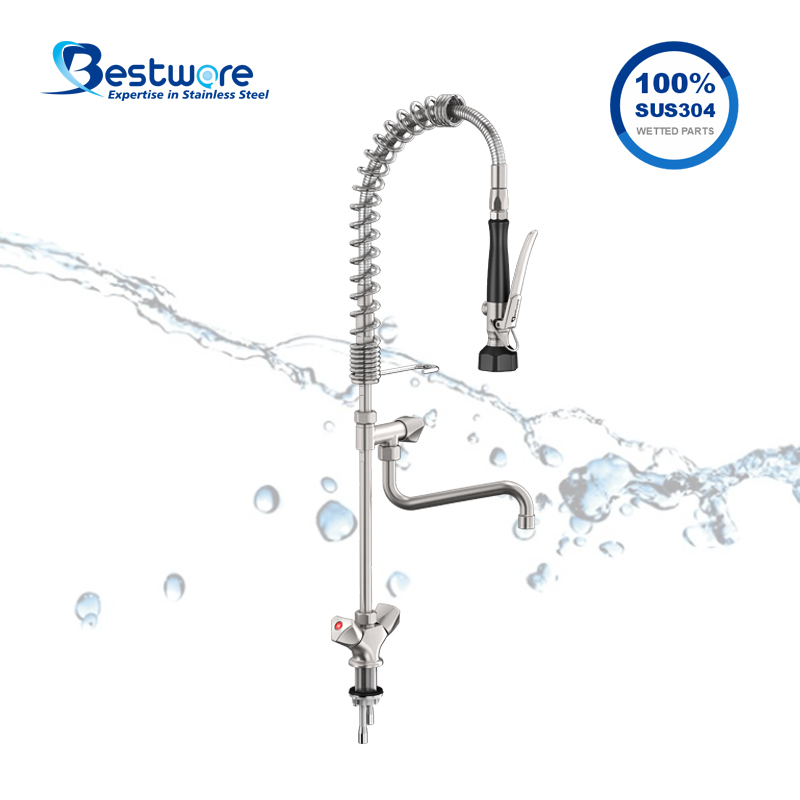
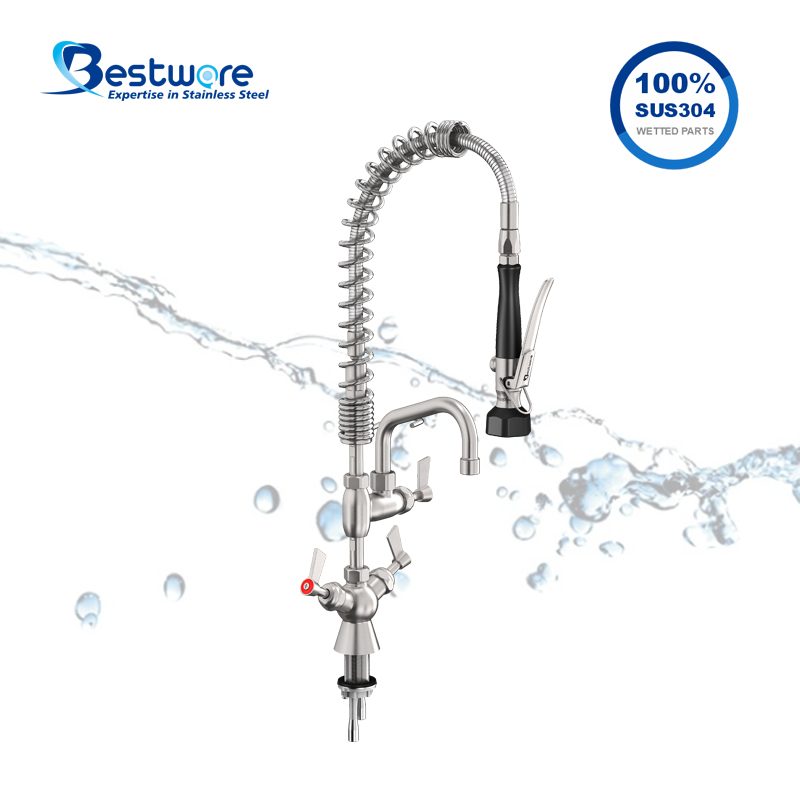
.jpg)
.jpg)
.jpg)
.jpg)
.png)
.png)
.png)
.png)