
Date: 2026-08-20
Sensor faucets have become a common fixture in commercial restrooms, hotels, hospitals, airports, office buildings, and other projects. For commercial projects, whether a product is easy to install depends on more than basic specifications such as size and material. The availability of a power supply, compatibility with the existing water lines, available installation space, and ease of on-site commissioning can all affect installation efficiency. Therefore, when selecting a commercial sensor faucet, it is important to look beyond the product's functions and appearance and consider the installation details that are easy to overlook. Understanding these factors in advance can help reduce on-site modifications and rework, while allowing the product to better adapt to different commercial installation conditions.
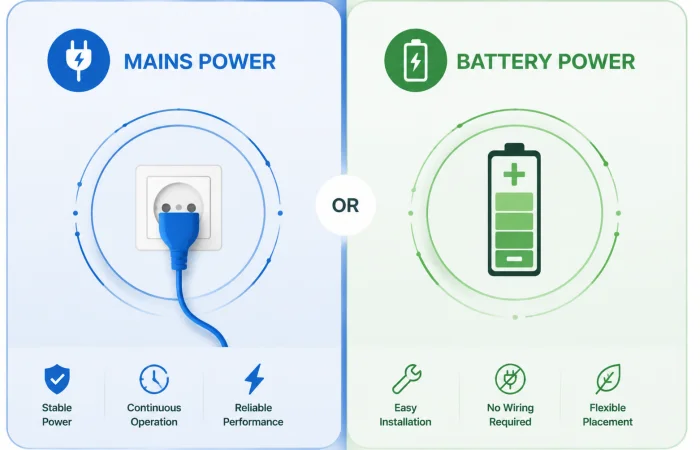
The power supply is one of the key factors that distinguishes sensor faucets from traditional mechanical faucets, and it is one of the first considerations before installation.
Traditional faucets do not require electrical power, so installation mainly focuses on the water supply. Sensor faucets, however, rely on stable power for their sensors, solenoid valves, and control systems. For new commercial projects, the power supply can usually be planned in advance during the design stage. Once the faucet location is determined, the corresponding power supply can be reserved at the same time.
However, conditions can be very different in hotel renovations, restroom upgrades, and commercial store renovations. Walls, countertops, and water lines may already be completed. If no power supply was originally reserved for the sensor faucet, adding new wiring may require additional electrical work. In such cases, the faucet's power supply options can directly affect the installation method.
Mains power is well suited to new commercial projects where the electrical layout has already been planned. Once the power supply is in place, installers can complete the connection according to the reserved wiring. Battery power provides another option for projects without a reserved power supply, particularly for renovation projects or installation environments where rewiring is inconvenient.
From an engineering perspective, more flexible power supply options allow a product to adapt to a wider range of site conditions. This does not mean that one power supply method is necessarily better than another. Rather, it means that the product's power supply design should match the actual requirements of the project. Considering this during the selection stage can help prevent the need to redesign the electrical layout after the product arrives on site.
If the power supply determines whether a sensor faucet can be properly connected to its control system, the water supply design directly determines whether the product can be properly connected to the existing water supply system. For installation projects, water connections involve more than simply checking whether the connection specifications match.
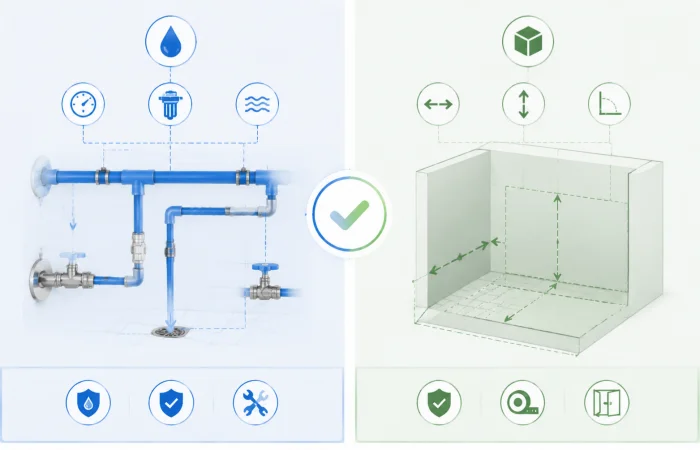
Commercial sensor faucets may involve hot and cold water inlets, water mixing, and solenoid valve control. Therefore, before installation, it is necessary to confirm that the faucet's water inlet configuration is compatible with the existing hot and cold water lines. This is particularly important in renovation projects, where the existing piping locations may already be fixed. If the connection points of the new product differ significantly from the existing installation conditions, additional adapters or adjustments to the piping may be required. Therefore, during the procurement stage, in addition to confirming the product specifications, it is important to check the locations of the hot and cold water lines, connection sizes, and piping layout in advance. These checks may seem simple, but they can effectively prevent situations where the product arrives on site only to find that the existing conditions are incompatible.
In addition to water connections, installation space is another factor that is often overlooked. Commercial restrooms generally aim to maximize the use of available space, and the area beneath a sink may already contain drain pipes, angle valves, water treatment equipment, or other components. Even if the sensor faucet itself can be installed, limited working space around the connecting pipes and related components can still make installation difficult. Therefore, installers need to consider more than just the faucet's length, height, and mounting hole size. They should also consider whether there will be sufficient working space for the water pipes, connectors, and other components after installation.
For wall-mounted sensor faucets, the wall preparation, water inlet location, and mounting position should also be confirmed in advance. If the product does not match the existing installation provisions, the piping may need to be adjusted or even the wall structure modified, which can clearly increase installation difficulty. Therefore, for commercial projects, a proper installation design should ensure a good match between the product dimensions and the available site space, rather than simply pursuing a compact product structure.
One of the biggest differences between sensor faucets and conventional faucets is that the sensor system also needs to be commissioned after installation. This means installers must not only complete the water and electrical connections but also ensure that the sensor works properly in the actual installation environment.
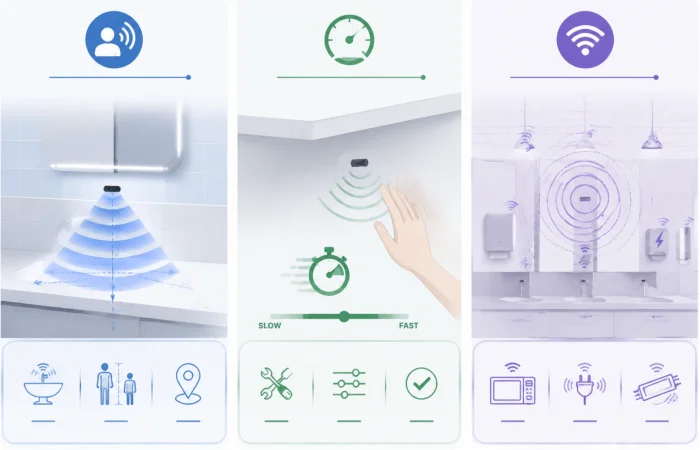
The sensor is typically integrated into the faucet body, so its surrounding environment can directly affect sensing performance. For example, when a faucet is installed in a relatively confined sink area, nearby walls, countertops, or other fixed structures may fall within the sensing area. In commercial restrooms where multiple faucets are installed side by side, the distance between adjacent faucets must also be considered to prevent their sensing areas from interfering with one another. Therefore, basic on-site testing should be performed after installation to confirm that the faucet responds properly when a user approaches and stops normally when the user moves away, while avoiding unnecessary activation caused by surrounding fixed objects. This is why installing a sensor faucet cannot simply be understood as three steps: "mount, connect, and power on." Whether the sensor position is compatible with the surrounding environment is also part of the installation design.
Response speed is another factor to consider during commissioning. If the sensor responds too slowly, installers may need to wait longer during testing before confirming whether the system is operating properly. If the system is overly sensitive, however, the risk of false activation may increase. Therefore, an effective sensor system is not simply about being "as sensitive as possible." It needs to achieve a balance between response speed, sensing stability, and interference resistance. For example, a rapid response time of approximately 0.2 seconds allows users to receive water quickly when they approach the faucet and also enables installers to verify sensor performance more efficiently.
Residential environments generally contain fewer electronic devices, whereas hospitals, airports, hotels, and large commercial complexes may contain numerous lighting systems, motors, automatic doors, elevators, and other electronic equipment. Complex electromagnetic environments can potentially affect electronic control systems. If a sensor faucet has insufficient interference resistance, installers may need to spend additional time troubleshooting false activation or abnormal response after installation. Therefore, although interference resistance is not a direct "installation step," it can still affect the efficiency of on-site commissioning in commercial projects.
After considering the power supply, water connections, and sensor system, purchasers can evaluate a commercial sensor faucet from a more comprehensive engineering perspective during the selection process.
First, confirm that the product is compatible with the site conditions, including the power supply location, hot and cold water lines, mounting hole, and available countertop or wall space. If these basic conditions are not compatible, even a well-designed product may increase on-site installation difficulty.
Second, consider whether commissioning after installation is straightforward. Factors such as whether the sensing area is easy to adjust, whether the system responds consistently, and whether the electronic control system can adapt to the site environment can all affect the time required for installers to complete final commissioning.
Finally, consider whether the project involves large-scale installation. For residential use, spending an additional ten or twenty minutes installing a faucet may not be a major concern. Commercial projects, however, may involve dozens or even hundreds of units. If every unit requires additional installation time due to power supply, water connections, or commissioning issues, the resulting labor costs can quickly add up.
Therefore, the installation convenience of a commercial sensor faucet should not be judged simply by "how long it takes one person to install one unit." Instead, it should be evaluated based on whether the product can maintain a high level of consistency across different installation points, allowing installers to follow a standardized installation process.

To address common installation conditions and engineering requirements in commercial projects, Bestware incorporates factors such as power supply, installation configuration, and sensor systems into the design of its commercial sensor faucets.
In terms of power supply, selected models offer both mains and battery options, allowing them to be chosen according to the conditions of new construction or renovation projects and reducing the need for additional wiring when no power supply has been reserved.
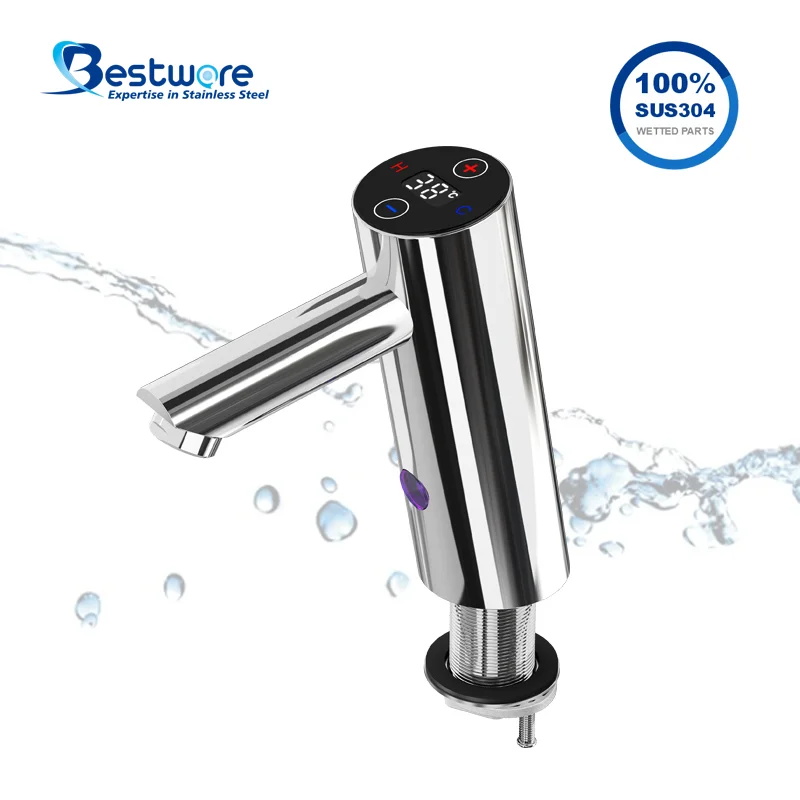
For the sensor system, the faucets use high-sensitivity sensing technology with a response time of up to 0.2 seconds and are equipped with a 10V/m interference-resistant solenoid valve to enhance sensing stability in complex commercial environments. For hot and cold water models, the intelligent thermostatic system combined with digital temperature control makes on-site temperature adjustment more intuitive, while pressure-sensitive temperature control helps maintain a more stable water temperature.
Different installation configurations are also designed to meet different engineering requirements. For example, the wall-mounted model features a built-in check valve, further considering water connection and maintenance convenience in wall-mounted installation environments.
The purpose of these designs is not simply to add more product features, but to help sensor faucets better adapt to the actual installation conditions of commercial projects and reduce unnecessary adjustments from product selection through on-site installation.
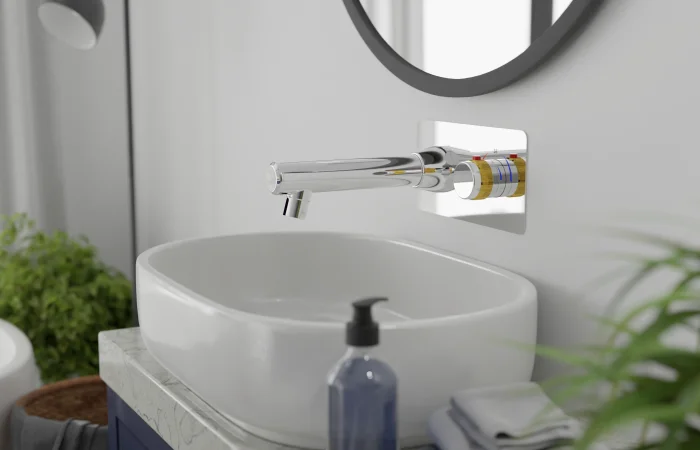
The installation difficulty of a commercial sensor faucet is rarely determined by a single visible structural feature. Instead, it is influenced by multiple details hidden within the product design. The power supply determines whether the product can adapt to different site conditions; the water supply design affects whether the hot and cold water lines can be connected properly; installation space determines whether installers have sufficient working clearance; and the sensor system affects the efficiency of commissioning after installation. For contractors, designers, and purchasers, a commercial sensor faucet that is truly suitable for project applications should not only meet the needs of end users, but also achieve a good balance between site compatibility, installation efficiency, and ease of installation. These are the factors that truly deserve attention when evaluating the engineering value of a commercial sensor faucet.
One-stop Solution Provider of Stainless Steel Commercial Faucets
Email: business@bestware-stainless.com
after-sales@bestware-stainless.com
Tel: +86 18929047065
WhatsApp: +86 18929047065


WeChat: +86 18929047065


Website: www.bestware-stainless.com(Global Site)
www.bestware-sparkling.com(Water Dispenser)
Add: Block 8, No. 6, Jianda Nan Road, Jiangmen, Guangdong, China
Copyright © Bestware Hardware Production Co., Ltd. All Rights Reserved.
.webp)
(7).webp)
(6).webp)
(5).webp)